Nature
 PUBLISHED


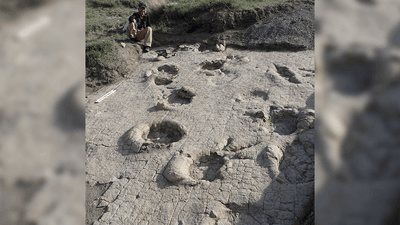


A set of giant dinosaur footprints in northern Mongolia has been discovered after being lost for more than 70 years. The site provides evidence that a region rich in small dinosaur fossils from the late Cretaceous also supported giant sauropods and theropods millions of years earlier.
The rest of this article is behind a paywall. Please sign in or subscribe to access the full content.You might think it would be hard to lose 70-centimeter (28-inch) long footprints, but Mongolia is among the world’s least densely populated countries, so once you get out the capital, there’s a lot of empty space. In the Saizhurakh area of northern Mongolia, a site reported in 1950, but whose location was insufficiently documented, has been rediscovered, and it’s richer than anyone could hope, with 31 huge prints.
The prints were made in the Shinekhudag Formation, laid down around 120 million years ago in the clay and sand of a fluctuating lake floor during the early Cretaceous. When low water levels allowed the sand layers to form, dinosaurs made their way across the area, perhaps seeking the remaining water.
Two trackways were made by sauropods more than 15 meters (49 feet) long. The makers were of similar size, and one appears to have been following the other so their prints overlapped, like a herd of elephants.
More remarkable is that there are suspected tracks from five theropods, which based on the size and spacing of their footprints were 7.4-8.8 meters (24-29 feet) long, although only one is considered definitive. Ecosystems cannot support too many large carnivores, so five of them walking on the same patch, probably on the same day before the mud hardened, raises some questions as large as the trackmakers about the circumstances.
Certainly, these were big beasts. The largest had a footprint 57 centimeters (22 inches) long. Although it’s easy to jump to the idea that they were hunting in packs – as if not terrifying enough on their own – the directions in which the theropods were moving appear random. Consequently, it is more likely that some rich feeding opportunity had drawn all of them to the same spot independently.
North America had plenty of large theropods in the early Cretaceous, and it is known many dinosaurs were moving from Asia to North America then, so their presence in east Asia is not surprising. Indeed, evidence has been found of giant dinosaurs in what is now China, Japan, and South Korea around this time, but the absence from Mongolia and eastern Russia has been notable.
Although the planet was much hotter than today, so far from the moderating influence of the sea, the northern interior of Asia would have experienced extreme seasons unlike anywhere else. That probably included bitterly cold winters, so the possibility large dinosaurs simply avoided the area could not be ruled out before this discovery.
The conditions that preserve footprints and bones are different, so the two do not always go together. However, the scientists who made the rediscovery note the presence of gravel-bearing sand layers nearby, which they think might contain bones or teeth of the animals that made these tracks.
The study is published in Ichnos.