Nature
 PUBLISHED





Picture the scene: you are a small theropod dinosaur settling down to take a nap in Cretaceous Myanmar. The Sun has set and the clouds have descended, but a different kind of light is glittering just above: fireflies. An idyllic moment worthy of an Owl City song, and one that's supported by a remarkable lump of amber dating to the mid-Cretaceous.
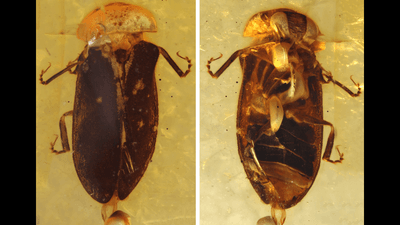
The rest of this article is behind a paywall. Please sign in or subscribe to access the full content.The recently announced amber fossil from northern Myanmar contains the preserved remains of a 99-million-year-old firefly, marking the oldest known evidence of these luminous beetles.
There have been previous examples of glowing beetle fossils from this time period, but they belonged to different subfamilies. That’s why this latest fossil is being celebrated as the first “true Luciolinae fossil from the mid-Cretaceous”.
The specimen also represents a new species. It’s been named Cretoluciola birmana, combining its family (Luciolinae for “little light”) with its origin in time (creta, meaning Cretaceous). Its latter name, birmana, is a reference to Myanmar, where the amber fossil was found.
That "little light" is made possible through something known as bioluminescence, a chemical reaction that releases energy as light. The reaction occurs between oxygen and a group of small compounds called luciferins, and it is catalyzed – the scientific term for “sped up” – by an enzyme called luciferase.
Incredibly, this 99 million-year-old fossil still has evidence of a two-part organ associated with bioluminescence. This suggests it was lighting up the night sky just like other members of the Luciolinae do today.
The firefly is a male and just 6.6 millimeters (0.26 inches) long, with large eyes and slender antennae – traits resembling those found in various extant beetles belonging to the family. Its confirmation as a member of this group suggests fireflies had already diversified by the age of dinosaurs, living complex lives supported by the ancient landscape.
“The life cycle of fireflies requires a diverse range of ecological niches to be fulfilled,” write the authors. “The environmental elements upon which they depend include leaf litter and water sources for egg-laying, larval growth and foraging activities. Additionally, understorey vegetation and shrub structures are crucial for adult foraging and courtship.”
“In their larval stage, fireflies may inhabit aquatic, semi-aquatic or terrestrial environments, while adults rely on trees and other plants to facilitate their bioluminescent displays. The complex environment of Cretaceous Myanmar is supposed to have been capable of satisfying these requirements.”
The study is published in the journal Proceedings of the Royal Society B.