Nature
 PUBLISHED



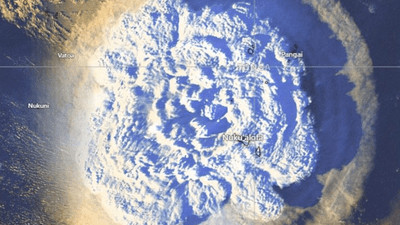


The Hunga Tonga–Hunga Ha’apai eruption of 2022 involved a self-cleaning mechanism scientists hadn't seen before, considerably reducing the anticipated long-term atmospheric consequences. The chemistry involved could provide a solution to the challenges of measuring how effective we are at mitigating methane emissions.
The rest of this article is behind a paywall. Please sign in or subscribe to access the full content.Volcanoes have both warming and cooling effects on the planet. The ash and aerosols they release block sunlight, which cools things down, but carbon dioxide and methane are greenhouse gases and heat things up. The combination usually triggers short-term cooling, followed by net warming because the gases stay in the atmosphere much longer than the particles.
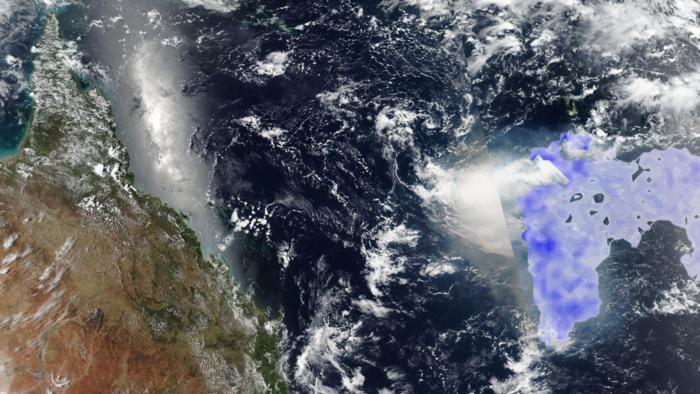
Satellite advances let atmospheric scientists study Hunga Tonga–Hunga Ha’apai far more closely than any previous eruption of similar size. Although the eruption released 330,000 tons of methane, equal to a year’s worth of burps from two million cows, the authors of a new paper discovered something unexpected: some of it didn’t last long. Instead, methane was converted to formaldehyde (HCHO), which then transformed into carbon dioxide and water.
“When we analysed the satellite images, we were surprised to see a cloud with a record-high concentration of formaldehyde. We were able to track the cloud for 10 days, all the way to South America. Because formaldehyde only exists for a few hours, this showed that the cloud must have been destroying methane continuously for more than a week,” said Maarten van Herpen at Acacia Impact Innovation in a statement. “It is known that volcanoes emit methane during eruptions, but until now it was not known that volcanic ash is also capable of partially cleaning up this pollution.”
Methane from uncapped wells or burping cattle usually lasts about 10 years in the atmosphere. Although that isn't as long as carbon dioxide, it warms the planet so much more that it is the much more potent greenhouse gas per ton released. If it only lasted a few days, however, methane would be almost harmless from a climate perspective.
It’s only three years since scientists learned of a previously unknown mechanism that accelerates the breakdown of methane on the other side of the planet. Dust from the Sahara mixes with the salt in sea spray as it travels over the Atlantic ocean, producing iron salt aerosols. When exposed to sunlight, the sodium chloride salts break down, releasing chlorine that destroys nearby atmospheric methane.
“What is new—and completely surprising—is that the same mechanism appears to occur in a volcanic plume high up in the stratosphere, where the physical conditions are entirely different,” said Matthew Johnson at the University of Copenhagen, who worked on both discoveries.
Because the Hunga Tonga–Hunga Ha’apai eruption took place under the ocean, it threw vast amounts of salty water into the atmosphere, along with the iron-rich volcanic ash. The resulting plume therefore had all the right ingredients to make methane-killing chlorine, and so it did.
“We now know that atmospheric dust—for example from a volcanic eruption—impacts the methane budget, meaning the budget of how much methane is added to the atmosphere and how much is removed. Because dust has not previously been taken into account, it is important that we correct the data on which these estimates are based,” Johnson said.
In the long run, carbon dioxide is the gas doing the most to destabilize the climate, but because methane’s effect is more immediate, many climate scientists argue it should be the more urgent focus of our attention. Given the political obstacles to cutting back on the methane released in fossil fuel extraction and meat production, a way to accelerate its breakdown looks appealing.
Research is ongoing on releasing iron-salt particles to accelerate methane breakdown, but it has run into a verification problem. “How do you prove that methane has been removed from the atmosphere? How do you know your method works? It’s very difficult,” Jos de Laat from the Royal Netherlands Meteorological Institute said.
Satellites can only measure typical methane concentrations where a lot of light is reflected back from Earth’s surface, which doesn’t happen over the oceans. Direct carbon dioxide capture from the atmosphere may be hideously expensive, but at least you have a product you can weigh at the end of it.
Hunga Tonga–Hunga Ha’apai might offer the answer: look for the formaldehyde. The research was done using the TROPOMI instrument aboard the European Space Agency’s Sentinel-5P satellite, but TROPOMI was never designed to measure formaldehyde. The team had to do some careful adjustments for the observations to work, but they have now demonstrated this could be done in the future.
The study is open access in Nature Communications.