Nature
 PUBLISHED
 1
1


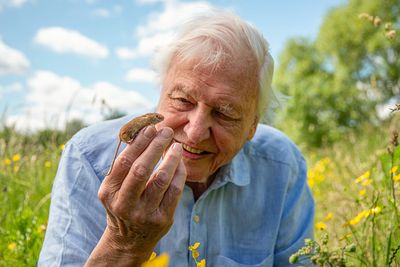


Sir David Attenborough turns 100 on Friday, May 8, which much of the world rightly sees as an excellent reason to celebrate his 74 years of outstanding documentary-making.
The rest of this article is behind a paywall. Please sign in or subscribe to access the full content.IFLScience agrees, and we'd like to add an extra point: like a fine wine, Sir David has only gotten better with age, and not only because of improvements in technology that have allowed us to hear his dulcet tones over ever more incredible footage – even real-looking dinosaurs – but because of a direction he has purposely taken in his later years.
Reaching this milestone gives an opportunity to consider the sweep of Sir David's achievements after almost three-quarters of a century on our screens. Hopefully, some people will take the opportunity to view his films that came out before they were born.
That work raised the bar on nature documentaries in many ways and introduced generations of viewers to the workings of the natural world, including evolution. Nevertheless, for a long time, his work left important things unsaid.
There is a powerful irony in the fact that Attenborough's documentary-making provides a record of the wonders of nature just when those wonders are more threatened than at any time in the past 65 million years. Centuries from now, perhaps people will study the footage his teams collected – probably including segments that were never aired – to learn about animals and plants that will by then be long extinct.
Indeed, it is likely that entire ecosystems will have been wiped from the Earth by overharvesting, pollution, the arrival of invasive species, and, most of all, climate change, in the coming centuries. Nature documentaries and some museum exhibits will be all our descendants have left.
To the extent these species and environments survive, a great deal of credit will be owed to Attenborough, but one criticism that has been made of him is that he left sounding the warning bell until too late. Since then, however, he has been making up for lost time, working the damage humans are doing planet-wide into all of his films and series in the last 20 years, as well as sometimes highlighting potential solutions that might be scaled up.
It's often said that people won't save what they don't love, and they won't love what they don't know. For most of humanity, the only way we get to know nature's most spectacular and intriguing representatives is through our televisions and computer screens. Although everyone from former presidents to Hollywood royalty has turned their hand to narrating the workings of the natural world, no one holds a candle to Attenborough.
Silicon Valley inventor, engineer, and now policy worker Saul Griffith, who advised President Joe Biden on US energy transformation and is now leading projects to get his native Australia off fossil fuels, has attributed his defense of nature in part to Attenborough. “There wasn't any religion in the house other than Attenborough documentaries,” Griffith told the Guardian. Griffith added that this meant that when he started to see signs of damage, he realized, “Holy shit, we've got a lot to lose.”
Not everyone made the leap Griffith did, however. Attenborough's immense popularity, particularly after the 1979 global success of the Life on Earth series, led activists to implore him to be more vocal about saving the ecosystems he portrayed. For a long time, his response was limited.
Although he would answer questions about his views when interviewed, his documentaries focused on nature's positives. When threats were mentioned at all, he often referred to overpopulation as the driver, ignoring the damaging effects brought about by a wealthy minority who harm the planet far more than the average individual.
However, in recent years, Attenborough has become much more willing to use his voice, both on screen and off. In 2000, he made State of the Planet, a three-part documentary about the ecological crisis. Although this alerted many people to the danger we are in, it is notable how little climate change features in the footage.
Pollution is discussed as one of the five ways in which humanity is doing damage, but mostly in the context of more immediate impacts, not the effects of greenhouse gases.
Six years' later, Attenborough devoted two hour-long films to a discussion of anthropogenic climate change, the first presenting the evidence it is happening and the second discussing prospects for turning things around. At least outside Britain, however, these were overshadowed by Al Gore's An Inconvenient Truth, which came out in the same year.
Nevertheless, 2006 marked a turning point, followed by films such as Our Fragile Planet and Attenborough's Ark, in which he chose 10 animals he would prioritize saving if given the chance. The current decade has included documentaries focused on extinction and the changes Sir David has witnessed in his long career as a naturalist.
Perhaps Attenborough's most powerful contribution has been the Our Planet series, in which each episode combines some of the most spectacular footage yet with examples of the dangers the natural world faces due to human activities.
Though still almost universally loved, Attenborough's highlighting of climate dangers has made him a target for smears from the fossil fuel industry and outspoken climate change-deniers in more recent years. Our Planet's horrifying footage of walruses falling to their deaths because a warmer climate had melted the sea ice on which they normally rest became a particular target. Four years later, baseless claims that his film crew had covered up a more natural cause than melting sea ice from human-caused global warming continued to gain space in major media outlets, voiced by climate-denier lobbysists.
In the UK, where Sir David is certainly regarded as a national treaure, the Global Warming Policy Foundation (a climate denial think tank comprised mostly of non-scientists) has also repeatedly denounced Attenborough and even lodged complaints with the BBC for supposedly misleading the public in 2019's Climate Change: The Facts and for the depictions of polar bears that have adapted to hunt different prey due to reduced sea ice in his series Seven Worlds, One Planet. The organization even sent a video to all headteachers in the UK in 2020 with a message from their own polar bear "expert" in an attempt to discredit Attenborough, blaming him for causing climate youth anxiety.
According to a recent poll by communications agency Diffusion, though, Attenborough remains comfortably the UK's most trusted voice on science and the environment. Nevertheless, these smears may still have done some damage, as 41 percent of those polled did not chose him from a list when asked who they trust on the topic. This is concerning because Attenborough won't live forever, and with no clear successor with a global platform and trusted reputation like his to keep the topic of climate change at the forefront of our understanding and appreciation of the natural world, a space may become open that can all too quickly get filled with misinformation and polarization.
To anyone who cares about the future, however, it's the increased willingness to stick his head out and speak up that makes Sir David most heroic. It takes immense talent to captivate audiences as he does, tying together the footage collected by thousands of photographers and researchers throughout his long career. It also takes courage to stand up to one of the world's most powerful and ruthless industries. For that, more than anything, we thank David Attenborough on his birthday.