Nature
 PUBLISHED
 1
1




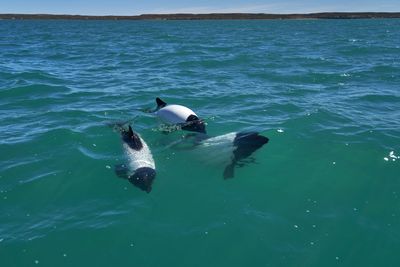


Seeing dolphins or whales on a day out at the beach might be one of the most magical wildlife encounters that can happen in the natural world. But when that species is the rarely seen “skunk” dolphin, the joy only multiplies, as happened to Rich Brand off the coast of the Falkland Islands.
The rest of this article is behind a paywall. Please sign in or subscribe to access the full content.Skunk dolphins, also known as panda dolphins, get their nicknames from their unusual black and white appearance, but are formally known as Commerson’s dolphins. There are actually two main groups of Commerson’s dolphins; the ones that Brand saw are the population that live in South America around Argentina, Chile, and the Falkland Islands (Cephalorhynchus commersonii commersonii). This subspecies is slighter smaller and can grow to 1.46 meters (around 4 feet 8 inches) and weigh around 45 kilograms (99 pounds).
Another population lives off the coast of the Kerguelen Islands in the southern Indian Ocean (Cephalorhynchus commersonii kerguelenensis). This puts the two populations at a distance of 8,500 kilometers (5,300 miles) apart, though no one is quite sure how this happened. These dolphins are typically bigger than their south American counterparts, reaching 1.8 meters (5 feet 11 inches) long and 86 kilograms (190 pounds).
Brand recorded the dolphins in shallow waters as they came right up to him, seemingly with no fear. "I saw them in the distance, and I knew they were in the area," Brand told SWNS. "I pulled out my phone to capture them as I saw them approaching me."
These dolphins prefer to remain close to shore in shallow waters and can sometimes be seen swimming along the edge of kelp beds. The dolphins feed on fish, crustaceans, and cephalopods, though this varies by region. Their social groups can be made up of as many as 100 individual dolphins, but they are more typically found alone or in small groups.
While the species is listed as Least Concern by the IUCN, the dolphins face threats from fishing nets, where they become entangled and are hauled out as bycatch. One interesting threat is the rise in demand for a food source for farm-raised salmon – this, in turn, creates pressure on mackerel and anchovy populations, a prey species for the dolphins.
While these animals are pretty rarely seen, the playful creatures have on some occasions been filmed swimming upside down.
"It is always a treat to experience the wildlife in nature," said Brand.