Nature
 PUBLISHED



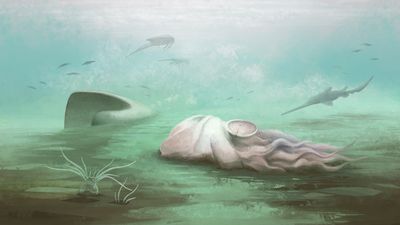


The year 2000 was, in so many ways, momentous. It was a new millennium, which always come with a doomsday prophecy or two; we were all scared of the millennium bug; there was no such thing as Google images yet; and we couldn’t even party like it was 1999 anymore.
The rest of this article is behind a paywall. Please sign in or subscribe to access the full content.But of course, the biggest upset came in the cephalopod world. That was the year palaeontologists in Illinois published the first description of Pohlsepia mazonensis, a fossil that “fundamentally challenged our understanding of cephalopod evolution when it was interpreted as the oldest known octopus,” explains a new paper, published today in the Proceedings of the Royal Society B.
It was big news. Previously, it was generally thought that octopods first diverged from their sister cephalopods in the Jurassic period, around 150 million years ago. But Pohlsepia doubled that, “predating previous estimates by over 150 million years,” notes the paper.
Still, the evidence was – well, not overwhelming, to tell the truth, but it was at least highly suggestive. The fossil had a “distinctive 'sac-like' fused head and mantle, symmetrical fins, paired eyespots, and arm crown with both arms and specialised tentacles,” the authors explain; it had eight arms, or 10, depending on how you count, and none showed any obvious signs of having suckers, hooks, or any of the other features associated with octopods. But with no evidence of any protective hard shell, the describing authors concluded it had to be an octopus – albeit a very early, confusing example of the order.
Now, however – with the advantage of more than two decades’ worth of technological advances – the same fossil tells a different story. “Pohlsepia is a nautiloid,” declares the new paper; still a cephalopod, but about as far away from octopuses as it’s possible to be within that class.
“[Pohlsepia] is not a cirrate octopus,” the authors write. “In turn, [this] places serious doubt over a Palaeozoic origin for the major crown coleoid lineages.”
The story of Pohlsepia
From the moment Pohlsepia was first announced, it was controversial. While its discoverers described a range of octopoid features to justify their decision – not just the many arms and lack of hard shell, but also its crown, fins, and funnel – many of those were disputed by their peers.
The evidence wasn’t strong enough, some experts argued; a single, poorly preserved specimen was simply not so compelling as to rewrite the entire fossil record. Those features that, to Pohlsepia’s describing authors, placed it convincingly into octopus territory, were seen by others as open to interpretation – was this a shell-less organism with fins, for example, or were those fins in fact the remains of a long-degraded shell?
Moreover, the fossil lacked a bunch of features that would typically mark something out as an octopus. There were no suckers or cirri on the arms; no beak, ink sac, or radula tongue that were beyond question. Over time, “even seemingly unequivocal anatomical characters have come under scrutiny,” points out the new paper, with investigations into structures previously assumed to be light-sensitive eyespots finding no evidence of the kinds of cells normally found in octopuses’ – even fossilized ones' – eyes.
Plus, there was the simple fact that, well, it just didn’t fit. Like a puzzle piece from the wrong box, Pohlsepia seemed to interfere with the overall picture of octopus evolutionary history – but remove it, and everything came back into harmony again. “When P. mazonensis is excluded from molecular clock analyses, studies consistently support a Mesozoic origin for crown Octobrachia,” the authors explain, “[which] aligns well with the earliest unequivocal fossil evidence of crown octopods from the late Jurassic.”
So, when palaeontologists and biologists began to quietly ignore Pohlsepia, reverting to a timeline they knew to be more strongly confirmed, it was understandable. Pohlsepia was noted in studies as a point of interest, sure – but not considered as part of the evolutionary story of octopodes, at least until more or better evidence came to light. Meanwhile, new studies started suggesting that perhaps it wasn’t an octopus at all, but a member of the Cnidaria – aquatic invertebrates such as jellyfish, hydroids, corals, and anemones.
It was, basically, an evolutionary mess. And why? Because nobody could see what had been left behind in the rock.
Discovering Paleocadmus
“It turns out the world's most famous octopus fossil was never an octopus at all,” said Thomas Clements, Lecturer in Invertebrate Zoology at the University of Reading in the UK and lead author of the new paper, in a statement. “It was a nautilus relative that had been decomposing for weeks before it became buried and later preserved in rock.”
“That decomposition is what made it look so convincingly octopus-like,” he explained. It turns out the animal’s toothed radula was there after all – but it had fallen slightly away from the main body and become obscured by the rock around it. It took highly advanced synchrotron and multispectral imaging of the site to find what had been missed back in 2000: a radula with at least 11 teeth, and parts of a beak.
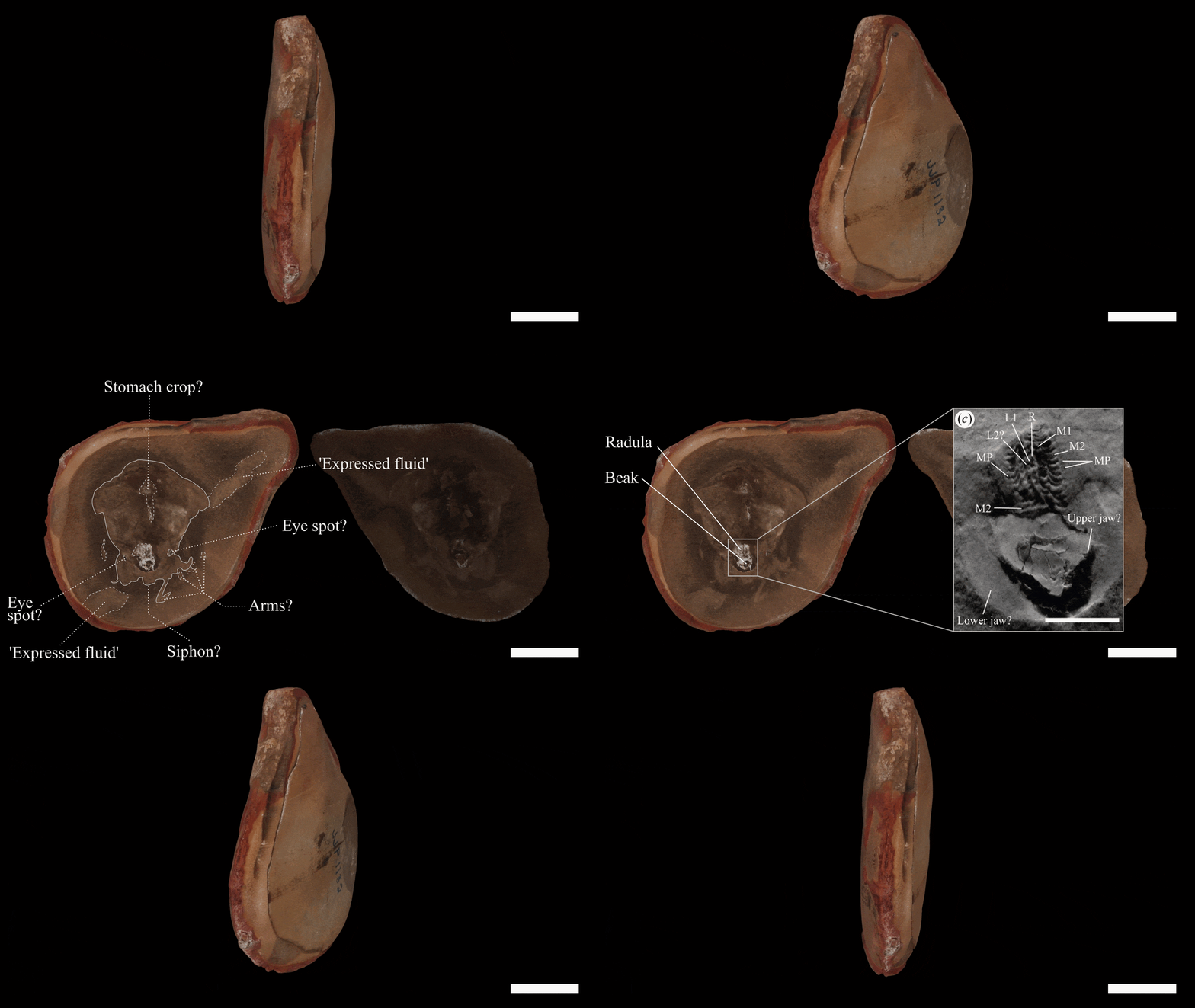
Both parts were incomplete, but their mere presence was enough to confirm it: Pohlsepia was a cephalopod alright, but no octopus. They only have seven or nine teeth; nautiluses on the other hand have 13, but the loss of one or two is to be expected after rotting in mud and chilling in rock for a few hundred million years.
In fact, the team discovered more. Not only was this a nautiloid, but it was one they recognized – the fossil was similar, and in many ways identical, to another discovery from the same site: Paleocadmus pohli, “the only unequivocal nautiloid soft tissue known from the Palaeozoic fossil record,” per the authors.
“Based on the morphological evidence presented here, we determine that [Pohlsepia] is synonymous with, and by order of precedence should be referred to as, Paleocadmus pohli,” they declare.
Re-rewriting history
This may seem like bad news – a groundbreaking discovery nullified; the octopus relegated once again to the evolutionary newcomer in the class. But with this new confirmation of a Paleocadmus pohli, the researchers are nevertheless celebrating.
And why wouldn’t they be? The story of octopus evolution once again makes sense – they have, essentially, solved a decades-long palaeontological mystery. And, while they may have knocked one record-holder off its perch, it was only to install another: “We now have the oldest soft tissue evidence of a nautiloid ever found, and a much clearer picture of when octopuses actually first appeared on Earth,” pointed out Clements.
“It's amazing to think a row of tiny hidden teeth, hidden in the rock for 300 million years, have fundamentally changed what we know about when and how octopuses evolved,” he said.
"Sometimes, reexamining controversial fossils with new techniques reveals tiny clues that lead to really exciting discoveries.”
The study is published in the journal Proceedings of the Royal Society B Biological Sciences.