Nature
 PUBLISHED



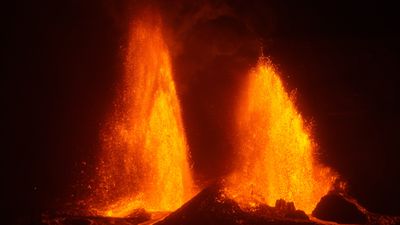


Which country has the most volcanoes? It’s got to be somewhere like Indonesia, right? There are plenty of eruptions there, after all. Or maybe Russia, given how huge it is. You wouldn’t be far off with either of those answers – but they’re both still wrong.
The rest of this article is behind a paywall. Please sign in or subscribe to access the full content.It’s actually the US that has the most volcanoes in the world; according to the Smithsonian’s Global Volcanism Program, the country has 165 of them that have erupted during the last 12,000 years. The US is in first place by a pretty long way too, with Japan coming in second with nearly 50 fewer volcanoes, followed by Russia and Indonesia.
We were initially a bit thrown off when we first saw those statistics. It’s not like we don’t know that the US has volcanoes – safe to say we’re very aware that there’s a supervolcano lurking under Yellowstone – but it doesn’t feel like it should top the list, at least not in comparison to places where an eruption seems like more of an everyday threat.
Indonesia, for example, comes in at fourth place with 101 volcanoes – but it’s the most volcanically active country on the planet, and millions of people live within only a short distance from a volcano.
But when you look at the geography of the US, the surprise of its many volcanoes quickly disappears.
Most of the USA’s volcanoes are in Alaska, while the rest are found along other parts of the western US – like in the Cascade Range that stretches all the way down from Washington into Northern California – and Hawaii.
Those in Alaska and the west sit along what’s known as the “Ring of Fire” – an iconic Johnny Cash song, yes, but in this case, a 40,250-kilometer (25,000-miles) horseshoe-shaped stretch around the Pacific Ocean that’s the most volcanically (and seismically) active area in the world.
Its frequent activity comes down to plate tectonics; the Ring of Fire just so happens to be where a bunch of Earth’s other tectonic plates meet the largest one, the Pacific plate. When these plates bump into one another, the denser plate pushes underneath the less dense plate in a process known as subduction. As it goes, the denser plate melts into magma, which rises up through the plate above, and eventually… BOOM. You’ve got yourself a volcanic eruption.
The most recent of this kind of eruption in the US was in 1980 at Washington’s Mount St. Helens, which ended up being the most destructive in the history of the country. In terms of erupted material, however, the 1912 eruption of Mount Katmai in Alaska was far larger; this explosive volcanic temper tantrum spat out around 13.5 cubic kilometers (3.2 cubic miles) of magma, making it the world’s largest eruption in the 20th century.
But what about Hawaii? It’s home to one of the world’s most active volcanoes in the form of Kīlauea, but unlike Mount St. Helens and Mount Katmai, it isn’t found along the Ring of Fire. It does, however, sit over what’s known as a hotspot.
This is a region of the mantle (the layer beneath Earth’s crust) that’s abnormally hot compared to the surrounding rock, and as a result, buoyant plumes of material rise up through the mantle and crust, erupting on the surface as a volcano.
Those eruptions can last for a good while too; Kīlauea has been erupting for a well over a year at present, and it’s resulted in some pretty spectacular sights, from “volnadoes” to record-breaking lava fountains.