Humans
 PUBLISHED





The Cold War was full of outlandish plans, audacious decisions, and steps too far, but few were bigger or bolder than the time they nuked the edge of outer space. The short-term result was some dazzling sights, but the consequences were so alarming that these reckless tests were promptly banned across the world (and beyond).
The rest of this article is behind a paywall. Please sign in or subscribe to access the full content.Its name was Operation Fishbowl, a sequence of military experiments conducted in 1962 in which the US detonated several nuclear bombs high in the atmosphere above the Pacific Ocean.
Its goal was to determine how high-altitude blasts affected radio communications, radar, and satellites. Some also wondered whether a nuclear detonation in the atmosphere could act as a crude shield from incoming missiles. However, in the relentless one-upmanship of the Cold War, another likely factor was that the USSR was starting to toy around with its own high-altitude nuclear tests. To prove their technological and military might, the Americans had to get there before the Soviets did.
Under Operation Fishbowl, all of the missiles were set to be launched from Johnston Island, part of the remote Johnston Atoll controlled by the US Air Force, located in the middle of the Pacific Ocean some 1,300 kilometers (over 800 miles) southwest of Hawaii. Keeping with the tropical theme, the individual tests were given a collection of oddly aquatic names: Bluegill, Starfish, Starfish Prime, Bluegill Prime, and Bluegill Double Prime.
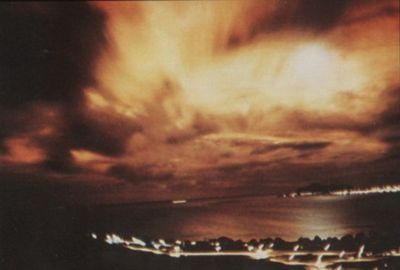
The most infamous of all was Starfish Prime. On the night of July 9, 1962, a Thor missile carried a 1.4-megaton nuclear warhead into low-Earth orbit, detonating approximately 400 kilometers (250 miles) above Johnston Island – well above the Kármán line, the official boundary of space, which sits at 100 kilometers (62 miles) above the Earth.
Unlike a conventional nuclear blast, a detonation at that altitude doesn't produce a classic fireball, mushroom cloud, or shockwave. Because the atmosphere is so vanishingly thin, there is simply no medium for those phenomena to form. Instead, the bomb releases its energy as intense radiation and high-speed plasma, creating a strangely silent, expanding orb of light.
Within seconds of the Starfish Prime explosion, the sky across the Pacific was filled with an unnatural glow, especially curling wisps of artificial aurora, and an eerie silence.
“The visible phenomena due to the burst were widespread and quite intense; a very large area of the Pacific was illuminated by the auroral phenomena,” one eyewitness of the event wrote in a military report.
“No sounds were heard at Johnston Island that could be definitely attributed to the detonation. Strong electromagnetic signals were observed from the burst, as were significant magnetic field disturbances and earth currents,” the report notes.
“A brilliant white flash burned through the clouds rapidly changing to an expanding green ball of irradiance extending into the clear sky above the overcast. From its surface extruded great white fingers, resembling cirro-stratus clouds, which rose to 40 degrees above the horizon in sweeping arcs, turning downward toward the poles and disappearing in seconds to be replaced by spectacular concentric cirrus-like rings moving out from the blast at tremendous initial velocity, finally stopping when the outermost ring was 50 degrees overhead.”
“They did not disappear but persisted in a state of frozen stillness,” the report continues.
But it wasn’t just a harmless light show. The shower of high-energy particles caused significant electrical damage across Hawaii, knocking out streetlights, disrupting telephone networks, and triggering alarms across Honolulu.
Above the surface, things were even worse. Together with a similar high-altitude test by the Soviets in October 1962, it’s estimated that one-third of the satellites in orbit were broken by the waves of radiation. This included the world’s first commercial communications satellite, AT&T's Telstar 1, which was (somewhat naively) launched the day after Starfish Prime. By February 1963, it had stopped working, with its electronics frazzled beyond recovery.
The scale of the damage is all the more striking when you consider that there were only 22 satellites in orbit at the time. Today, there are over 15,000, with the number growing rapidly. If something like Starfish Prime were to occur in the 21st century, the consequences would be catastrophic; GPS and other navigational tools would be downed, financial systems that depend on satellite timing would collapse, essential weather forecasting would be impossible, and global communications would go dark.
Operation Fishbowl also encountered several mishaps. The most disastrous occurred on July 25, 1962, during Bluegill Prime, when the Thor missile system exploded prematurely on land, sprinkling Johnston Island with plutonium and other nasty contaminants. The operation was paused for several weeks, but it continued with a string of new tests: Double Prime Checkmate, Bluegill Triple Prime, Kingfish, and Tightrope.
The good news is that the world did eventually learn from the mistakes of Operation Fishbowl. The fallout caused by high-altitude tests helped galvanize both the US and USSR with the Limited Nuclear Test Ban Treaty, which was agreed in August 1963, prohibiting nuclear detonations in the atmosphere, underwater, and in space. This was followed by the Outer Space Treaty in 1967, which further restricted the deployment and use of nuclear weapons in space.
It was a rare moment of clarity in which two rival superpowers recognized together that they had crept too close to the edge, and carefully stepped back.