


 Humans
 PUBLISHED

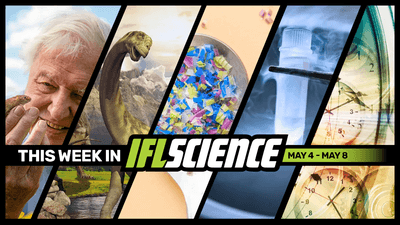


This week, RFK Jr. has said you have a spoonful of plastic in your brain, but do you really? A transplant of testicular tissue that was frozen for nearly 20 years has successfully produced sperm, and a new paper argues that black holes and quantum entanglement could allow us to send messages back in time. Finally, we spoke to NASA scientists to ask about the logistics behind a human mission to Saturn.
The rest of this article is behind a paywall. Please sign in or subscribe to access the full content.Create an IFLScience account to get all the biggest science news delivered straight to your inbox every Wednesday and Saturday.
David Attenborough Turns 100 This Week – Here's Why He's Become Even More Iconic In Old Age
Sir David Attenborough turned 100 on Friday, May 8, which much of the world rightly sees as an excellent reason to celebrate his 74 years of outstanding natural history documentary-making. Like a fine wine, Sir David has only gotten better with age, and not only because of improvements in technology that have allowed us to hear his dulcet tones over ever more incredible footage – even real-looking dinosaurs – but because of a direction he has purposely taken in his later years. Read the full story here
Dinosaurs May Have Been Sneakily Existing For 10 Million Years With No Clear Fossils
The diversity of early dinosaur fossils and the rate at which they evolved suggests the original dinosaur long predated the earliest specimens we have found. A new study takes a rigorous approach to this question and estimates that “dinosaurs emerged between 250 and 240 [million years ago], at least 10 million years before the earliest unambiguous dinosaur fossils.” Read the full story here
RFK Jr Says You Have A Spoonful Of Plastic In Your Brain – But Do You Really? We Asked The Experts
At a press conference on April 2, US Health and Human Services Secretary Robert F. Kennedy Jr announced the launch of a $144 million program to measure, study, and eventually remove microplastics from the human body. Reaching for a number to convey the urgency of the problem, he cited research that "reports concentrations [of plastic] in the brain equivalent by mass to roughly a spoonful," a value he said "has gone up by 50 percent since 2016. And inevitably, it's going to go up exponentially if we continue along the same road." Read the full story here
First-Ever Transplant Of Testicular Tissue Frozen For Nearly 20 Years Found To Produce Sperm
For the first time, frozen testicular tissue collected from a patient when they were a child has been successfully transplanted back into them as an adult and found to produce sperm. The groundbreaking trial demonstrates a proof of concept that could, in the future, help men who have undergone chemotherapy or other medical procedures in childhood retain their fertility in adulthood. Read the full story here
How Black Holes And Quantum Entanglement Could Send Messages Back In Time Like In "Interstellar"
Even if it is impossible to travel in time, there might be more hope for sending messages backwards, a new paper argues, despite the potential paradoxes. The idea is a central feature of the film Interstellar, and physicists want as much as anyone to know if it could work, but call it retrocausal communication, perhaps because it looks better on grant applications. Read the full story here
TWIS is published weekly on our Linkedin page, join us there for even more content.
Feature of the week:
"The Round Trip Lasts A Long Time, 17 Years Out And Back”: Could We Send A Human Mission To Saturn?
We have traveled to space for 65 years, and in that time the farthest distance we have reached was achieved this April, with the Artemis II crew. They got 406,771 kilometers (252,756 miles) from our home planet. That is about 1.36 light-seconds away; the extent of the human foray into the cosmos. How far could we send humans if we wanted to? Probably not very far. Still, we asked a NASA rocket scientist about what would be the exact cause of death of going well beyond the current plans for human exploration. Read the full story here
More content:
Have you seen our e-magazine, CURIOUS? Issue 46, May 2026, is available now. This month, we asked, “Do Other Animals Have Pets?” – check it out for exclusive interviews, book excerpts, long reads, and more.
PLUS, the We Have Questions podcast – an audio version of our coveted CURIOUS e-magazine column – continues. In episode 20, we ask, “Can You Learn To Roll Your Rs?”
Our Break It Down podcast now has a new monthly format, coming at you in both audio and visual. So tune in each month to hear about some of the wildest science stories and adventures we’ve been on. Kick off this month with “Artemis II Records, Neanderthal Not-Hybrids, And Introducing ‘Moon Joy’”
The Big Questions season 6 returns in June 2026, so here's our season 5 bonus episode to tide you over until then: Can Magic Be Used As A Tool In Science? You can catch up on the whole of season 5 here.

 7
7