Space and Physics






We have traveled to space for 65 years, and in that time the farthest distance we have reached was achieved this April, with the Artemis II crew. They got 406,771 kilometers (252,756 miles) from our home planet. That is about 1.36 light-seconds. The extent of the human foray into the cosmos. How far could we send humans if we wanted to? Probably not very far. Still, we have looked into the matter of what would be the exact cause of death of going well beyond the current plans for human exploration.
The rest of this article is behind a paywall. Please sign in or subscribe to access the full content.If, for some reason, we were to send some people to Mars right now, things might be difficult and dicey, but we would likely be able to make it a success. At its closest, the trip there would take just seven months, and there might be a way to come back even more quickly. So, let’s consider something bolder. Let’s think of a human mission to Saturn.
What we showed is that it would be feasible to basically make the propellant from the stuff we have on Titan.
Geoffrey Landis
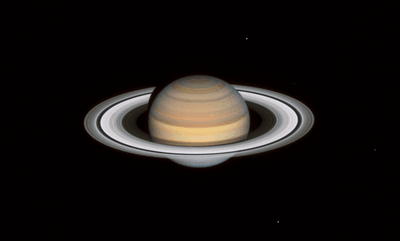
The plan is simple. You fly to Saturn, collect some samples from Enceladus, an icy moon with a deep ocean, and Titan, the largest moon with lakes of methane and complex chemistry, and then you fly back home. Easy peasy. How long would that take? Well, there was a study assessing the feasibility of a sample return mission to the Saturn system, and it suggested around 17 years.
“We started doing that with respect to the NASA Innovative Advanced Concepts Program,” study author Geoffrey Landis, physicist and rocket scientist at the NASA John Glenn Center, told IFLScience. “Well, what would be something that would be very challenging? And we said, well, nobody has ever looked at a sample return mission to Titan.”
A crucial aspect of space exploration, especially proposals that involve humans, is in-situ resource utilization. Basically, that means looking for what might be there in space that can be used to achieve the mission goal. In the Titan sample return proposal, the scientists realized they had a lot of technology already in place, and it is mostly feasible. They had a great idea to reduce the mass of propellant needed too; once you get to Titan, you spend a few years turning its methane-rich atmosphere and its buried water ice into fuel.
One actual challenge was the return vehicle, which needed to be refueled on Titan. They came up with different designs and approaches, considering a quadcopter at one point. The design they focused on was one that would inflate with the production of fuel.
“What we showed is that it would be feasible to basically make the propellant from the stuff we have on Titan,” Landis told IFLScience.
We want to give our hypothetical crew the best chance at surviving, so let’s assume that we are sending a few missions ahead so they can start producing fuel and send that into orbit with some samples. Our crew will fly across the Saturn system, snap the different samples, refuel at this interplanetary petrol station, and fly back home. This would shave a few years off needed to make the fuel, but we are still looking at a more-than-a-decade trip into outer space.
“The round trip lasts a long time, 17 years out and back, so it's not a fast mission,” Landis, who’s also a science-fiction writer, explained. “That's probably a little long for humans."
When it comes to rockets, you are also always considering the delta-v, a measure of the impulse per unit mass of the spacecraft needed to speed up, slow down, and change orbit. Our spacecraft ought to be big! You need fuel to move the spacecraft, and lots of it. Sure, you can try using some flybys of Earth and other planets, but a crewed mission cannot really be taken on a slow trajectory to save fuel.
The first thing I would really want to develop is the propulsion system to go all the way to Saturn and back. That's going to be a very, very long trip if you use existing chemical propulsion systems.
Geoffrey Landis
The mass you might save in fuel you might have to compensate with food, and for a 17-year trip, there would be a lot of it. Astronauts tend to consume a lot more calories than Earth-based humans, and given that we have not developed ways to produce food in space at scale (a few tomatoes does not count), you need to bring every meal for the whole trip. If we needed to cheat, we could go with some extremely calorie-dense food, like ghee, lard, or olive oil, but let’s give astronauts their required balanced diet and place about 2 kilograms (4.4 pounds) of food per astronaut per day. That’s over 12 tonnes of food per astronaut for the whole trip.
Everything about this undertaking is enormous, and we haven’t even talked about risks such as radiation in interplanetary space, which would require shielding in the spacecraft, adding even more weight to the whole affair. And as always, the problem goes back to your delta-v. The more mass you have to shift, the more fuel you need.
“The first thing I would really want to develop is the propulsion system to go all the way to Saturn and back,” Landis told IFLScience. “That's going to be a very, very long trip if you use existing chemical propulsion systems.”
“I would really like a higher thrust, higher specific impulse propulsion system. This would be a system that you'd really like to see a nuclear reactor, probably a nuclear thermal propulsion.”
NASA was studying that in the 1960s with Project NERVA, and the agency has been looking into it again as a possible way to take humans to Mars not over months, but weeks. One possibility places the travel time at 45 days, which is extremely manageable in terms of flying time alone. Saturn would still be several years away, but suddenly the door is open to a more realistic scenario.
If we want to most likely kill a crew, sure, we could send them to Saturn very soon with current technology. However, upcoming technology massively increases the odds of getting them to the famously ringed planet and back safe and sound.

 1
1