Space and Physics
 PUBLISHED




Artemis II had a very busy sixth day. On April 6, the four astronauts – NASA's Reid Wiseman, Victor Glover, and Christina Koch, and CSA's (Canadian Space Agency) Jeremy Hansen – broke all distance records for humans.
The rest of this article is behind a paywall. Please sign in or subscribe to access the full content.At 13:56 EDT, the Orion spacecraft broke Apollo 13's record of 400,000 kilometers (248,655 miles) from Earth, and by a wide margin; the astronauts got to 406,771 kilometers (252,756 miles) from us. It takes light about 1.36 seconds to cover that distance. So, they were 1.36 light-seconds away from the birthplace of us all. A drop in an ocean when we consider cosmic distances, but the deepest humans have traveled away from Earth and into the universe.
“At NASA, we dare to reach higher, explore farther, and achieve the impossible. That’s embodied perfectly by our Artemis II astronauts – Reid, Victor, Christina, and Jeremy. They are charting new frontiers for all humanity,” said Dr Lori Glaze, acting associate administrator for Exploration Systems Development Mission Directorate at NASA Headquarters in Washington, in a statement.
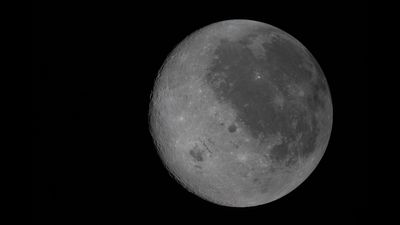
The day was also marked by scientific investigations of the far side of the Moon, with the crew spending time looking at features that included areas that no human had seen before directly. While Apollo astronauts flew behind the Moon, the celestial mechanics and the phases of the Moon during those passages had limited the amount of what could be seen by human eyes on the far side.
Two unnamed features on the Moon were also given proposed names by the crew. One has been called Integrity, after the name of the Orion spacecraft that has taken the astronauts around the Moon. The other proposal is for a crater named Carroll, after Commander Wiseman's late wife, who died of cancer in 2020 at the age of 46.
“A number of years ago, we started this journey in our close-knit astronaut family and we lost a loved one. And there is a feature in a really neat place on the Moon, and it is on the nearside/farside boundary. In fact, it’s just on the nearside of that boundary, and so at certain times of the Moon’s transit around Earth, we will be able to see this from Earth,” an especially emotional Hansen said to mission control.
“And so we lost a loved one. Her name was Carroll, the spouse of Reid, the mother of Katie and Ellie. And if you want to find this one, you look at Glushko, and it’s just to the northwest of that, at the same latitude as Ohm, and it’s a bright spot on the Moon. And we would like to call it Carroll.”
The names will now go to the International Astronomical Union for final approval. Apollo 8 and Apollo 13 astronaut Jim Lovell proposed, in 1968, that a pyramid-shaped mountain be called Mount Marilyn after his wife. That was only approved in 2017. Maybe Integrity and Carroll will get a faster approval.
Talking of Jim Lovell, the veteran Apollo astronaut, who passed away last August, recorded a message for the Artemis crew. A passage of the torch, so to speak, as Wiseman, Glover, Koch, and Hansen surpassed the record that Lovell, John Swigert, and Fred Haise achieved following the Apollo 13 accident.
Integrity is now on its way back to Earth. The crew is scheduled to return to Earth on Friday, April 10, 2026, around 8:07 p.m. EDT. The Orion capsule is planned to splash down in the Pacific Ocean off the coast of San Diego, California.



 1
1