Space and Physics
 PUBLISHED
 1
1






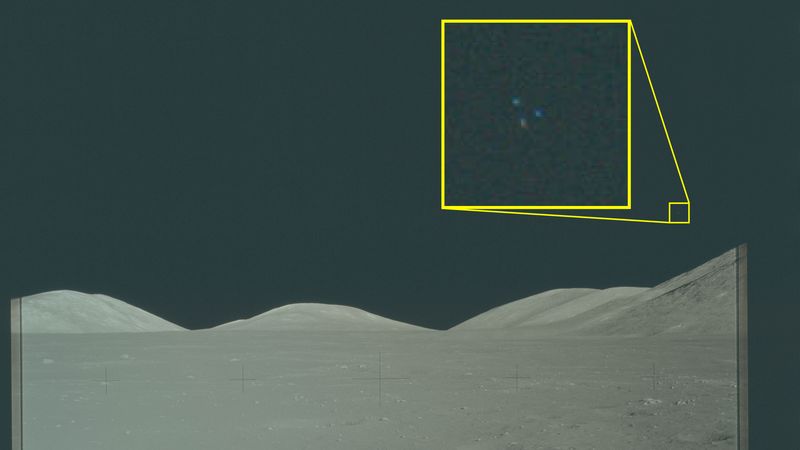
On May 8, the Pentagon released 161 government files related to unidentified aerial phenomena (UAPs), what we used to call UFOs. They include some never seen before material, but also files from the Apollo missions, both transcripts and images, that have been publicly available for decades. There is nothing exciting nor proof of alien life in them, but one file tickled us to no end. And it also made us wonder, what should we do in case we were to discover an alien civilization?
The rest of this article is behind a paywall. Please sign in or subscribe to access the full content.In 1963, Maxwell W. Hunter II from the Executive Office of the President wrote a memorandum on the “space alien race question.” The six-page document discusses plans in case we were to find alien intelligence, the possibility of life on Mars, diplomatic policy, and more. The whole memorandum is quite interesting, but its extremely frank and quite sassy conclusion on what to do in case of first contact is worth focusing on:
“There likely is nothing to be done at the moment to prepare for these possibilities (the only body of writing on the subject available in an emergency is science fiction), because no one of consequence is going to take this rubbish seriously unless it happens. At that point, our policy will be determined in the traditional manner of grand panic,” Hunter wrote.
Meeting ET: Panic, espionage, or just chatting chaos?
If we were indeed to meet an alien civilization, what would be the result? I feel if the alien just appeared in space over Earth or as a looming spacecraft over several US landmarks, we might panic a bit. But if we were to get a message or find evidence of a civilization on an exoplanet, then I think that panic would not certainly be the obvious or main reaction.
The closest planetary system is still four light-years away, and there’s no trace of artificial radio signals from it. With our current technology, and based on what we know about physics, there is no way to get to other solar systems, so the concerns should be massively reduced.
But a controversial paper in 2020, authored by Kenneth Wisian and John Traphagan, argued that having a message from an alien civilization could produce a real or perceived advantage leading to espionage, escalating conflicts between nations, and could even end up in all-out war. Many experts disagreed with that assessment.
Jason Wright, Chelsea Haramia, and Gabriel Swiney authored a study in 2022 showing that no nation would be able to monopolize communication or end up in a realpolitik advantage simply by having the right observatory looking at the right part of the sky at the right time.
“We argue that when it comes to searching space for radio signals, plotlines like you see in the films Contact or Arrival are unlikely because it's unlikely for it to be possible to monopolize communication with an alien species if contact is made, and it's unlikely that such communication would provide information that could be used for military advantage here on Earth,” the authors told IFLScience at the time.
When we thought we accidentally found aliens
You can prepare for something like it, but the real thing will always be more complex and different. Still, the SETI Institute did get a sort of dress rehearsal back in 1997, which makes Dr Seth Shostak, senior astronomer at SETI, agree with Wright, Haramia, and Swiney.
“What actually happens when you get a SETI detection is that the media immediately start calling you up. There is no secrecy in this work. Usually, within a few hours, everyone would know,” Dr Shostak told IFLScience.
Back in 1997, a signal was detected that was coming from outside the atmosphere, and it appeared to be artificial. Could it be aliens? It took the New York Times just 15 hours to find out that there was an odd detection and get in touch with SETI. The media was already covering it before it was revealed that it was just the telemetry signal from the SOHO spacecraft. There was no escalating conflict from it.
Transparency is key in the search for alien life
The release of these files has been mocked for being a nothingburger, with many online claiming it was a way to distract from the Epstein files or the war with Iran. However, it could be useful in the long term as a bulwark against those who believe in grand conspiracy theories about aliens and government secrets. Transparency and community engagement are key in challenging conspiracy mindsets, and not just from the people – from politicians too.
“This is what the SETI community settled on doing a long time ago, and it remains the best option. We also argue it's important to proactively explain SETI science in advance to policymakers and decision-makers to prevent the sort of scenario [Wisian and Traphagan] envision arising from misunderstanding,” Wright, Haramia, and Swiney told IFLScience.
What we should do if we find an extraterrestrial civilization
Is Hunter right in thinking that policy in case of an alien contact would be a panic rush? Maybe. There’s a lot of anti-expert sentiment and act first/think later in modern political actions and discussions. Still, there are many researchers working on so-called “post-detection protocols", looking at what we should be doing in case we actually find an alien civilization.
There is not really an agreed-upon consensus on the best approach, but there are some suggestions. In 2010, the International Academy of Astronautics (IAA) published the Declaration of Principles Concerning the Conduct of the Search for Extraterrestrial Intelligence. This states that after a compelling detection, there shouldn’t be a reply without international consultation.
It is possible, though, that if we spot a message, the aliens already know we are here. We are not being subtle. We are accidentally radio-loud. Our telephone masts and airport radar are detectable from many tens of light-years away, and maybe even farther away once our leaked signals get there.