Nature
 PUBLISHED



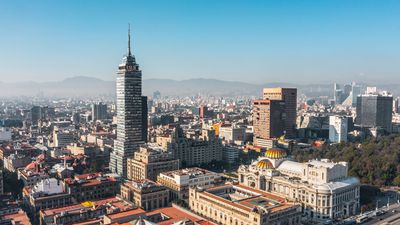


For over a century, experts have been aware that Mexico City is gradually sinking into an ancient aquifer. But now NASA has launched one of the most powerful radar systems ever developed into space, which is mapping its descent in real time.
The rest of this article is behind a paywall. Please sign in or subscribe to access the full content.Mexico City occupies land that was once part of Lake Texcoco, the largest lake in an interconnected system that filled the Valley of Mexico. Before the Spanish conquest, the Mexica built their capital, Tenochtitlan, on an island within the lake and managed flooding through a highly engineered system of causeways, dikes, and chinampas. But after the conquest, the Spanish authorities decided to expand the colonial city by dismantling many of these systems and eventually draining the lake to control flooding. This process, which unfolded across multiple centuries, transformed the landscape but also created lasting subsidence issues.
Now home to around 20 million people, extensive groundwater pumping and the growing weight of urban development has led to the compaction of the lakebed over the last century. In 1925, engineers first reported this phenomenon, which was noted again in the 1990s and 2000s after parts of the metropolitan area were found to be sinking by around 35 centimeters (14 inches) per year. This has resulted in damage to infrastructure, including the Metro, which is one of the largest rapid transit systems in the Americas.
Over the years, the city’s descent has been observed by several generations of space-based radars. But the new NISAR mission, which was launched in 2025, is now capable of seeing its progress with never-before-seen clarity. NISAR’s L-band synthetic aperture radar – which operates at 1-2 GHz frequencies offering high-resolution, all weather imagining – is designed to track subtle changes, such as land sinking or rising. It can also be used to track glacier movement and croplands growing, as it passes through the sky multiple times a month.
“Images like this confirm that NISAR’s measurements align with expectations,” Craig Ferguson, deputy project manager at NASA Headquarters in Washington, explained in a statement.
“NISAR’s long wavelength L-band radar will make it possible to detect and track land subsidence in more challenging and densely vegetated regions such as coastal communities where they may have the compounding effects of both land subsidence and sea level rise.”

According to preliminary measurements taken by NISAR between October 2025 and January 2026, parts of Mexico City are subsiding by over 2 centimeters (half an inch) every month. These areas are presented as blue spots on a new map that NASA has just released. Areas of the map that appear in yellow and red are regarded as residual noise signals and are expected to decrease as the satellite collects more data.
One of the more visible areas of subsidence is around the landmark known as the Angel of Independence, along the Paseo de la Reforma. The monument was built in 1910 to commemorate Mexico’s hundred years of independence. Over the years, the 36-meter (114-feet) tall monument has had additional steps put in place as land around it continues to sink.
“Mexico City is a well-known hot spot when it comes to subsidence, and images like this are just the beginning for NISAR,” David Bekaert, a project manager at the Flemish Institute for Technological Research and a member of the NISAR science team, added.
“We’re going to see an influx of new discoveries from all over the world, given the unique sensing capabilities of NISAR and its consistent global coverage.”
The NISAR satellite is the first to have two SAR instruments – L-band SAR, which measures 24-centimeter wavelengths and S-band SAR, which measures 10-centimeter wavelengths. It is designed to monitor the planet’s land and ice surfaces twice every 12 days using the spacecraft’s drum-shaped reflector to collect data. This makes it the largest radar antenna reflector NASA has ever sent into space.