Nature
 PUBLISHED
 1
1




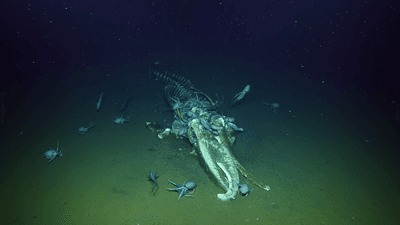


On the final dive of the E/V Nautilus’ expedition season in October 2019, during a live-stream no less, researchers stumbled across a rare discovery on the seafloor. As their camera penetrated the depths of the Davidson Seamount off central California’s coast, the skeletal remains of a whale came into view, to the team’s audible excitement.
The rest of this article is behind a paywall. Please sign in or subscribe to access the full content.“It’s a whale fall, whale fall…? WHALE FALL!” can be heard from the rapturous crew as they realized what they were looking at.
A whale fall is when a whale carcass sinks to the bottom of the ocean and comes to rest on the seafloor, supporting a whole new ecosystem and providing quite the banquet for a range of deep-sea beasties.
“Dinner is served,” as one team member put it.
In January 2023, the original footage of the discovery was exquisitely upscaled and remastered in 4k (video below).
Whale falls are pretty uncommon to come across. However, it's even rarer to find one that hasn’t already been picked clean. Most of the time, if researchers do manage to stumble across one, it has been resting on the seafloor for years.
This one, which was found at a depth of 3,238 meters (10,500 feet) in California's Monterey Bay National Marine Sanctuary, appears to be relatively "fresh" as it still has some soft tissue, blubber, and internal organs remaining.
Curiously, the carcass seems to be between stages of ecological succession, as large scavengers like eelpouts (eel-shaped fish) were spotted snacking on the blubber, while bone-eating worms had already started consuming the fats from the bones.
Other deep-sea creatures that joined in the feast included grenadiers, crabs, and at one point, at least 15 deep-sea octopuses. Octopuses are primarily predators, but as one researcher said, “Why not be opportunistic?”
As another put it: “Where food is so limited, scavenging is a great strategy... your food doesn’t run away.”
The whale is estimated to be around 4-5 meters (13-16 feet) long, and its baleen can still be seen, though the researchers haven’t clarified what species of whale it is yet. Baleen is the filter-feeding system of hair-like "teeth" inside the mouths of baleen whales like blue, humpback, right, and gray whales.
When the whale opens its mouth and takes in great gulps of water, it uses its tongue to push the water back out, and the filter traps tiny creatures like krill, which get left behind as snacks. Baleen is actually made out of keratin, the same stuff as your fingernails, hair, and animals' claws, horns, and hooves, and will eventually degrade.
While this whale’s mortal life has ended, its legacy will continue, nourishing a thriving community in the dark for years to come.
"The whale skeleton can support rich communities for years to decades, both as a hard substrate (or surface) for invertebrate colonization and as a source of sulfides from the decay of organic compounds of whale bones. Microbes live off of the energy released from these chemical reactions and form the basis of ecosystems for as long as the food source lasts," the National Ocean Service explains.
"At deep sea levels, this forms a new food web and provides energy to support single- and multi-cell organisms and sponges, thus adding to the ocean's food chain," they added.
An earlier version of this story was published in October 2019.