Space and Physics
 PUBLISHED





On Neptune and Uranus, where the atmosphere is rich in methane and high in pressure, it is likely that diamonds are formed before raining down from the sky.
The rest of this article is behind a paywall. Please sign in or subscribe to access the full content.Here on Earth, we get the best kind of rain. Diamonds might be nice, but only if they rain down on a planet of creatures alive enough to enjoy the sparkles, and that's a little difficult to achieve without water.
The universe is a weird and varied place, though, and other types of rain are possible. It's not just a choice between H2O and a shower of bling. On OGLE-TR-56b, a hot Jupiter found very close to its host star, for example, the atmosphere is thought to be so hot it rains molten iron.
Meanwhile, on exoplanet HD 189733b, the winds blow at around 8,690 kilometers per hour (5,400 miles per hour), and it probably rains glass, thanks to the silicate particles in the clouds.
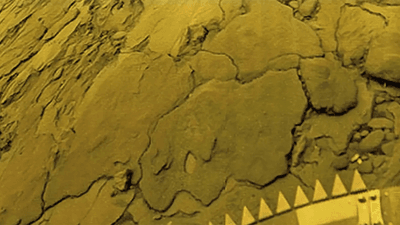
On Venus, the rain is unusual too, being both acidic and not falling down to the surface. From spectroscopic studies using telescopes here on Earth to assess the composition of Venus, and by dropping a series of probes into Venus's atmosphere, we have been able to determine that the global clouds hiding the planet's surface aren’t the kind you want raining down on your space crops.
"Venus’ atmosphere is one of extremes. With the hottest surface in the solar system, apart from the Sun itself, Venus is hotter even than the innermost planet, charbroiled Mercury," NASA explains.
"The atmosphere is mostly carbon dioxide — the same gas driving the greenhouse effect on Venus and Earth — with clouds composed of sulfuric acid. And at the surface, the hot, high-pressure carbon dioxide behaves in a corrosive fashion. But higher up in the atmosphere, temperatures and pressure begin to ease."
Sulfuric acid rain isn’t the kind you want falling on your head, even if you are aware it could be worse if it were a diamond downpour.
But, if you were able to endure the extreme heat (good luck with that, as Soviet Venus probes' lifespans were measured in minutes), there are plenty of places where you could go to hide from the acid rain. In fact, thanks to a phenomenon known as virga, pretty much anywhere on the surface will do.
You have probably seen virga, sometimes referred to as a "dry storm," here on Earth as well.
"Virga, from the Latin for 'rod' or 'branch' appear as light wisps which are attached to the base of a cloud and are often at their most striking when lit by a red sunset with a light wind extending the tail into an angled curve," the UK Met Office explains.
"Simply put, virga are trails of precipitation that fall from the underside of a cloud but evaporate or sublime before it can reach the earth's surface. This happens when falling rain or ice passes through an area of dry or warm air."
At the surface of Venus, temperatures reach the point where you no longer list it in degrees, but start casually mentioning that it would melt lead (around 467°C or 872°F, if you like the numbers), while atmospheric pressures are about 93 times what we see on our own planet at sea level.
As a result the planet has acid rain, sure, but it is stuck in a cycle of falling and evaporating long before it can get to the planet's surface.



 1
1