Space and Physics
 PUBLISHED
 1
1



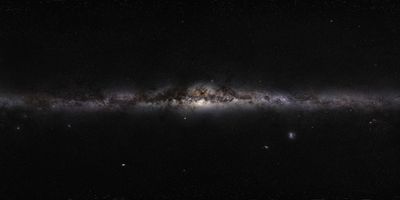


Our galaxy, the Milky Way, is of a respectable size. It got this big over its 13 billion years of life by also absorbing other, smaller galaxies around it. One of those building blocks, or maybe two, might have been found. Astronomers are reporting the motion of the chemical composition of a group of stars that might have belonged to a whole new galaxy. They've called it Loki.
The rest of this article is behind a paywall. Please sign in or subscribe to access the full content.There have been other galaxies absorbed by our own, like the Gaia-Sausage-Enceladus galaxy. To find Loki, the team looked at the light spectra of 20 stars that are in the solar neighborhood, within 6,500 light-years or so. The spectra allow the study of the chemical composition of these objects; these 20 stars have low traces of heavier elements beyond hydrogen and helium, the main components of stars. These kinds of stars are dubbed very metal-poor, which is often a tell that they formed in dwarf galaxies orbiting our own.
Hydrogen and helium (and a dash of lithium) formed right after the Big Bang. The nucleosynthesis of all the other elements happened in stars, and the elements were then spread about by supernova explosions and stellar winds. Dwarf galaxies tend to be smaller than galaxies like the Milky Way, so those explosions push away those heavy elements. The stars there remain more metal-poor.
We might have found one of the building blocks, which we dubbed 'Loki', that contributed to form our Milky Way.
Federico Sestito
The other tell is the motion or kinematics of these stars. Nine of the stars go around the galaxies in the opposite way as the rest, a retrograde motion. While the other 11 go around in the same direction of its rotation (prograde), they all have very elliptical orbits around the Milky Way.
“This study is novel as there was no other high-resolution spectroscopic campaign of these low-metallicity stars that move close to the Milky Way disc, and with observed spectra at such high quality,” lead author of the study Federico Sestito, from the University of Hertfordshire, told IFLScience.
“The kinematics of the oldest and most metal-poor stars is informative of the assembly of our galaxy. We might have found one of the building blocks, which we dubbed 'Loki', that contributed to form our Milky Way. We derived its mass and chemical evolution, including the various nucleosynthetic channels that contributed to the elemental abundances of these stars.”
The stars are all within the disk of the Milky Way – the region where the Sun is – which suggests that they must have joined the galaxy a long time ago. Simulations cannot provide an age for this collision beyond reasonable doubt, but it is possible that Loki joined the galaxy about 10-11 billion years ago. In that scenario, Loki was a galaxy weighing about 1.4 billion times the Sun, in terms of gas and stars.
“If the single scenario is not the case, the simplest alternative would be to have two formation sites: one site for the retrograde and one for the prograde population. These two systems would have had a very similar, if not identical, chemical evolution, with the same nucleosynthetic channels,” Sestito explained.
These two galaxies would also have to have had roughly the same mass as the Loki scenario and have entered the galaxy from the same maximum distance. So twin galaxies are a less likely, but still valid scenario. An upcoming survey expanding our knowledge of the chemical composition of nearby stars will help us understand more about the building blocks of our galaxy. The existence of Loki might be confirmed with that data.
The study is published in the journal Monthly Notices of the Royal Astronomical Society.