Space and Physics
 PUBLISHED






Trying to answer one question often leads to a whole bunch of other ones, especially for a writer. As I was learning about “rainbow clouds” recently, I discovered that they can happen beyond Earth too, and that got me wondering – do other worlds also have fully-fledged rainbows?
The rest of this article is behind a paywall. Please sign in or subscribe to access the full content.As it just so happens, IFLScience has its very own resident space rainbow expert, Space & Physics Editor Dr Alfredo Carpineti. I pestered caught up with him to find out the answer to our question.
How do rainbows form on Earth?
Before we get into that, however, it’s a good idea to know how the rainbows that we already know and love form. There are several explanations from mythology and folklore – ranging from the personification of Greek goddesses through to giant snakes and jungle demons – but there’s a scientific answer too.
“Rainbows here on Earth are caused by light getting refracted, internally reflected and dispersed by water droplets,” explains Dr Carpineti. “The liquid is incredibly important.” I was rooting for massive sky snakes, but alas.
Earth is the only world that we know of to have liquid water. But, in theory, the droplets required to produce a rainbow don’t explicitly have to be water, and we know that there’s a place beyond our planet that has another type of liquid (more on that shortly) – so the question about whether the phenomenon could exist on other worlds still stands.
So, what features should a liquid have for rainbow-making? “You need something where light splits into its component colors, with little absorption (so transparent), and obviously you need that liquid to be in the atmosphere,” says Dr Carpineti.
Invisible rainbows
One place where rainbows could happen is on Titan, Saturn’s largest moon. It’s the only place other than Earth that’s known to have liquids on its surface, in the form of hydrocarbons like methane and ethane. These can be found in rivers, lakes, and seas, but also in clouds, and rain.
Would rainbows made out of these liquid hydrocarbons look the same as the ones we know and love? Probably not. “Other worlds’ rainbows would only look similar if they were made of water rain,” explains Dr Carpineti.
We have seen glories on Venus and even on an exoplanet!
Dr Alfredo Carpineti
“Titan has hydrocarbon rain, which is great as methane is transparent,” he adds. “[But] what’s not transparent to visible light is Titan’s atmosphere, so only infrared light from the Sun get there.”
No dazzling array of color, then – but all hope is not lost. “The rain on this large moon of Saturn would work with infrared light, creating some lovely invisible rainbows.”
Researchers have captured rainbow-like stripes elsewhere in Saturn's system, above its moon Enceladus, but for now, rainbows on Titan remain hypothetical. “But we have seen glories on Venus and even on an exoplanet!” says Dr Carpineti.
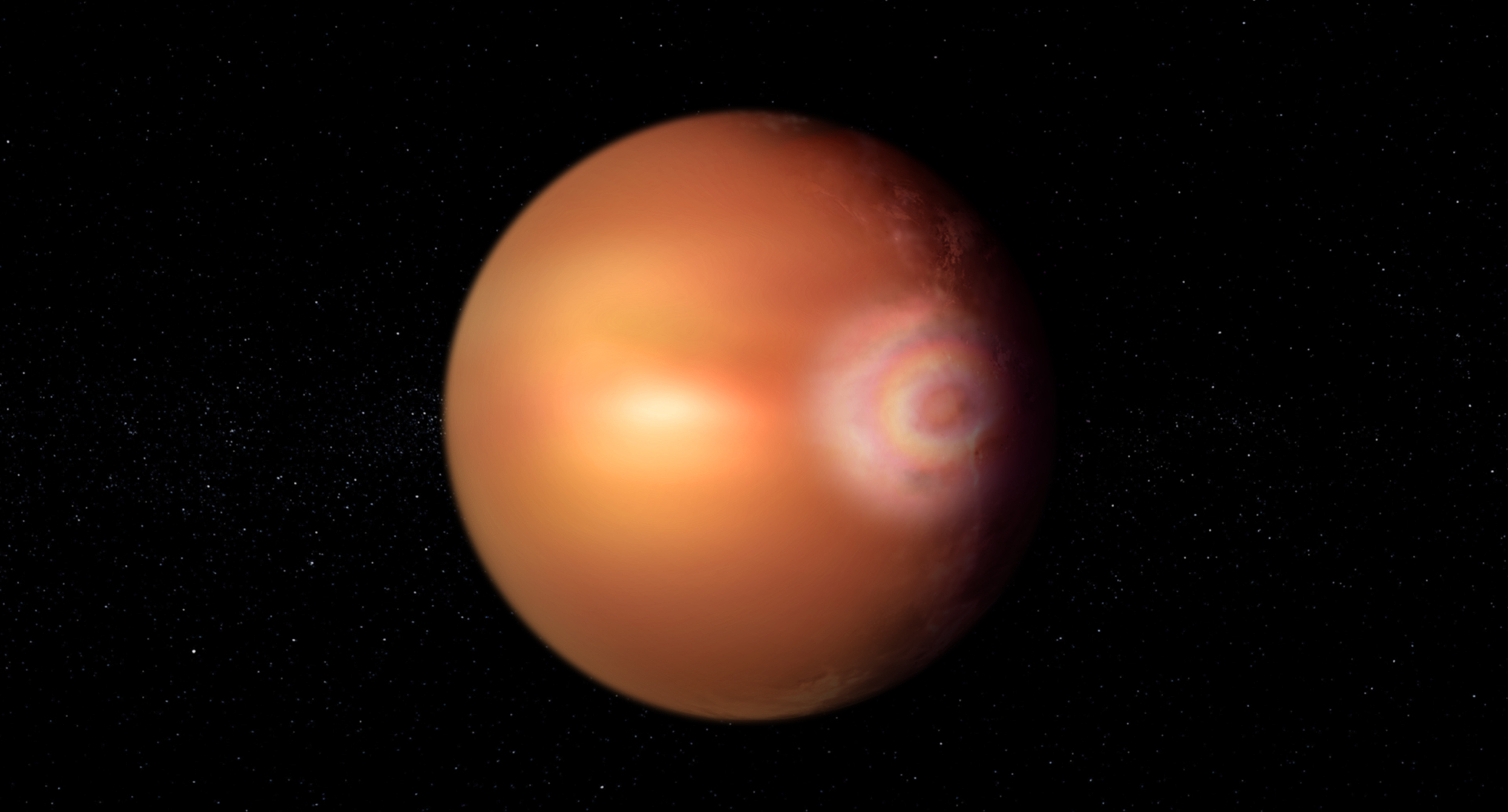
While they’ve got the same colors, glories are produced by a different process to rainbows; glories occur when droplets of liquid scatter light back towards its source, while rainbows involve refraction, reflection, and dispersal of light.
The exoplanet thought to have a glory was WASP-76b, a so-called “hot Jupiter” found in the constellation of Pisces – although the discovery of the phenomenon almost didn’t happen.
“I was involved in the first detection of asymmetrical light coming from this weird planet – and ever since I have been so curious about the cause. It has taken some time to get here, with moments where I asked myself – ‘Why are you insisting on this? It might be better to do something else with your time.’,” Dr Olivier Demangeon, first author of the study describing the finding, said at the time. “But when this feature appeared out of the data, it was such a special feeling – a particular satisfaction that doesn’t happen every day.”
The discovery also helps us to remember that we don’t just have to stick to thinking about optical phenomena like glories and rainbows as we know them here on Earth – Dr Carpineti says “we can be even more unconventional.”
In his upcoming book Invisible Rainbows, he explores refraction events across the wavelengths and phenomena. “For example, the very energetic light from around supermassive black holes can be refracted on the material around it, creating emission of different X-ray wavelengths,” Dr Carpineti explains. “An X-ray rainbow of sorts!”
X-ray rainbows? Color us intrigued.


 1
1