Culture and Society
 PUBLISHED





Every week it feels like a new conspiracy theory makes its way into social media. From Flat Earthers and antivaxxers to recent claims that the Artemis II mission was faked, conspiracy theories seem to be popping up everywhere. This phenomenon has gained a lot of academic attention in recent years, resulting in an impressive body of research. But at the heart of all this work is one important question that is often overlooked: how sincere are survey respondents who claim to endorse conspiracy theories? According to a new study, they may not be as trustworthy as you might think.
The rest of this article is behind a paywall. Please sign in or subscribe to access the full content.Although it is not clear to what extent there has been a rise in conspiracy beliefs within the wider public, we are experiencing a time when such ideas carry more weight. The COVID-19 pandemic brought with it an increase in conspiracy thinking that impacted public safety, undermining trust in vaccinations and specific health measures designed to combat the virus.
Over the last decade, psychologists have become increasingly interested in understanding why people hold to conspiracy beliefs and how to deal with them. Existing research has explored the origins of modern conspiracies that cover topics related to science, medicine, and politics, as well as the nature of the beliefs themselves and the types of personalities that are more likely to endorse them.
This work has provided valuable insights in the nature of the beast and has been used to inform empirically backed measures to address their spread. However, some recent research has drawn attention to a potential issue lurking within the data used to assess conspiracy beliefs. It seems not all survey respondents who supposed endorse conspiracy theories actually believe them.
There are potentially two reasons for why this may be the case. Firstly, respondents may provide feedback that unintentionally endorses a conspiracy theory they do not actually believe. This could be because the respondent is replying quickly and hasn’t really considered their answer or the question.
Secondly, a respondent who is actually paying attention may simply be trolling the researchers.
While it is possible to control for inattentive responders – many studies that do examine conspiracy theories actually exclude respondents who fail attention checks – this second one is trickier to catch, but it is nevertheless evidenced. For instance, the “birds aren’t real” movement, a satirical conspiracy theory claiming that birds are actually drones, has members who deliberately imitate other conspiracy theorists in their language, but without demonstrating sincere belief.
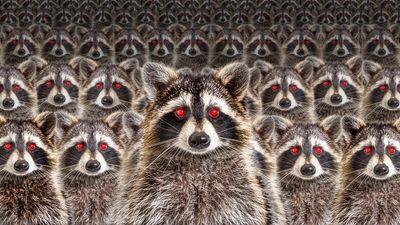
Perhaps the most entertaining evidence of the presence of insincere responses was provided by one study in 2024, which recruited 1,044 Australians through YouGov. It asked them to indicate how likely they thought several conspiracy theories were to be real. Mixed among the plausible and traditional conspiracies was a new and ridiculous one the researchers made up: that the Canadian Armed Forces were secretly developing an army of genetically altered raccoons to invade other countries.
Although this scenario would make for an entertaining movie, it is highly unlikely that anyone encountering the idea for the first time would take it seriously. And yet respondents endorsed the claim. Twenty percent of respondents either endorsed the theory or indicated that they had responded randomly or insincerely when asked about how they replied.
Clearly, not everyone who takes a survey can be trusted to answer honestly. But questions remain as to how much these insincere responses can distort important empirical findings.
To investigate this, researchers in Australia, New Zealand, Germany, and the UK attempted to probe sincerity. They recruited 1,020 participants in New Zealand and presented them with 13 conspiracy theories. Most were adapted from previous studies carried out in Australia and New Zealand, but the researchers invented two more that mixed international and New Zealand-focused conspiracy ideas.
Of course, the raccoon army conspiracy theory was added to the 13 beliefs. It was included as a way to measure sincerity. At the end of the survey, participants were explicitly asked, “Did you respond insincerely at any earlier point in this survey? In other words, did you give any responses that were actually just joking, trolling, or otherwise not indicating what you really think?”
It was stressed that participants would be rewarded regardless of whether they had lied or not.
“Respondents were classified as insincere if they rated the armed-raccoons conspiracy theory as Probably true or Definitely true, or they answered the direct question about insincerity with ‘yes’, or both”, the team explain in their paper.
In addition to these questions, the researchers also attempted to see whether the relationship between endorsement of conspiracy theories and supposedly well-established predictors – such as paranoia, the believe in a dangerous world, anxiety, cognitive reflection, and trust – changed after controlling for insincerity.
They measured this using standard itemized tests designed to capture this information.
The researchers found that 8.3 percent of participants indicated that they had responded insincerely at some point in the survey, while 7.2 percent explicitly endorsing the raccoon conspiracy theory. A total of 13.3 percent of respondents demonstrated one or both of these indicators of insincerity.
“Although respondents classified as insincere made up only 13.3 percent of the sample, they had fairly substantial effects on our prevalence estimates,” the researchers explained.
“Unsurprisingly, this inflation was most noticeable for the less commonly endorsed beliefs: for example, the percentage of respondents who endorsed the theory that ‘The 2010 and 2011 Canterbury earthquakes were deliberately triggered by the US military using electromagnetic pulses’ more than doubled (from 3.3 percent to 7.5 percent) when insincere respondents were included in the sample.”
The results underscore the importance of considering the possibility of insincere responses when examining the prevalence of beliefs in conspiracy theories.
One of the most interesting outcomes of this work was the endorsement of contradictory conspiracy theories. The team found that there was a relationship between insincerity and the supposed belief in ideas that contradicted one another. But more importantly, the majority of respondents who endorsed contradictory theories showed signs of insincerity.
“This finding suggests that researchers should be cautious about interpreting endorsements of contradictory conspiracy theories as evidence of contradictory or incoherent beliefs,” they argued.
When it came to the relationship between insincerity and the common predictors, the team found a significant correlation. This, they argue, provides evidence that the inclusion of insincere respondents can distort these relationships to a certain extent; however, this should not be overstated.
“This said, the relationships did remain statistically significant and in the same directions as reported in prior meta-analytic estimates even when conditioning on sincerity,” they added.
“As such, while we would strongly encourage researchers to consider insincerity when estimating relationships between endorsement of conspiracy theories and other predictors, this problem may not be an existential threat to the credibility of this body of work.”
The study is not without limitations, the most important of which is that the measures of insincerity have not yet been validated, so it is still unclear to what extent they are accurate.
“In our open-ended item, only a small proportion of those who endorsed the armed-raccoon theory indicated that they did so insincerely, a finding that implies substantial uncertainty about the validity of this item as an indicator of insincerity,” the authors explain.
“By contrast, many of those who endorsed the armed-raccoon theory showed signs of other forms of low response quality (e.g. inattentiveness, comprehension difficulties), and a substantial minority provided on-topic rationales.”
It is possible that this lead to some incorrect classifications of some sincere respondents with high levels of conspiracy theory beliefs. At the same time, the opt-in nature of the study cannot guarantee that participant sample was truly representative of the wider New Zealand population.
The study is published in Royal Society Open Science.

 1
1