Health and Medicine
 PUBLISHED
 3
3





People don't often volunteer themselves to be the focus of scientific investigation, but in 2016, Dr Evelina Fedorenko at the Massachusetts Institute of Technology (MIT) found herself with a more than willing subject in a woman known as “EG”. So named to protect her privacy, EG had contacted one of Fedorenko’s colleagues to see if she could contribute to research owing to her “interesting brain" – and it's really something.
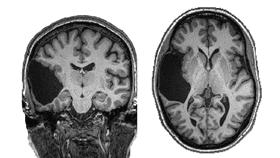
The rest of this article is behind a paywall. Please sign in or subscribe to access the full content.In 1987, a fortuitous scan at George Washington University Hospital revealed the unique nature of EG’s brain: it was missing the left temporal lobe. For those unfamiliar with the left temporal lobe’s job, it’s thought to be responsible for language processing in most people – and yet here was EG, speaking two languages.
Following the revelation, EG grew tired of doctors who made “pronouncements and conclusions without any investigation whatsoever,” she told Wired. However, when Fedorenko approached her case without preconceived ideas of her capabilities, EG agreed to get stuck in with the science.
The first paper regarding EG’s unique brain (led by PhD candidate at MIT Greta Tuckute) has since been published in the journal Neuropsychologia and centers around the role of the temporal lobe in language. In most people, the majority of the work in language processing takes place in the left temporal lobe, begging the question: how was EG so proficient with language?
Functional magnetic resonance imaging (fMRI) showed that EG’s brain had found a way to compensate with a fully functional language network sitting in its right hemisphere. How it adapted so well could have something to do with the timeline of the condition’s emergence.
“We find that—as expected for early left-hemisphere damage—EG has a fully functional language network in her right hemisphere [...] and intact linguistic abilities,” wrote the study authors. “However, we detect no response to language in EG's left frontal lobe.”
The missing lobe is expected to have been lost in early life when EG was a baby, possibly the result of a stroke. The gap left behind is now filled with cerebrospinal fluid.
Curiously, EG’s sister is also missing a temporal lobe, but on the right side instead, indicating there could be a familial connection to the condition. She is also seemingly unaffected by the missing brain region.
With one paper under their belts, EG and Fedorenko's team hope to continue building their body of research with more published studies.
"Though Dr Fedorenko’s studies answer some questions about how my brain is wired the same as or differently than a typical brain, it does not tell others who I am," wrote EG in a note in the paper. "Please do not call my brain abnormal, that creeps me out."
"For now, my brain is special, unique, and interesting, and I am excited that it can help neuroscientists understand the plasticity of the human brain."
[H/T: Wired]