Culture and Society
 PUBLISHED






Would you like a nice juicy steak? Yes? What if I told you it was made from a cow? What if I told you that cow was taken from its mother at 10 months old, and slaughtered at just 18 months at the latest – barely one-20th of the way through its natural lifespan, and the same relative age as maybe a third grader. What if I told you that little calf died slowly, hung upside-down as his blood flowed out of him, perhaps fully conscious and aware of his oncoming death? Would you still like a steak then? Undoubtedly, for some contrarian commenters out there, the answer is still yes. But according to a new study from psychologists at the UK’s University of East Anglia and Brock University in Canada, it takes a lot less than that to deter many people from eating a meat dish.
The rest of this article is behind a paywall. Please sign in or subscribe to access the full content.“By displaying images of live animals alongside meat-based dishes on university cafeteria menus, we observed a significant increase in the proportion of vegetarian meals sold,” the authors write. “These findings demonstrate that linking meat to its animal source can produce measurable behavioral changes.”
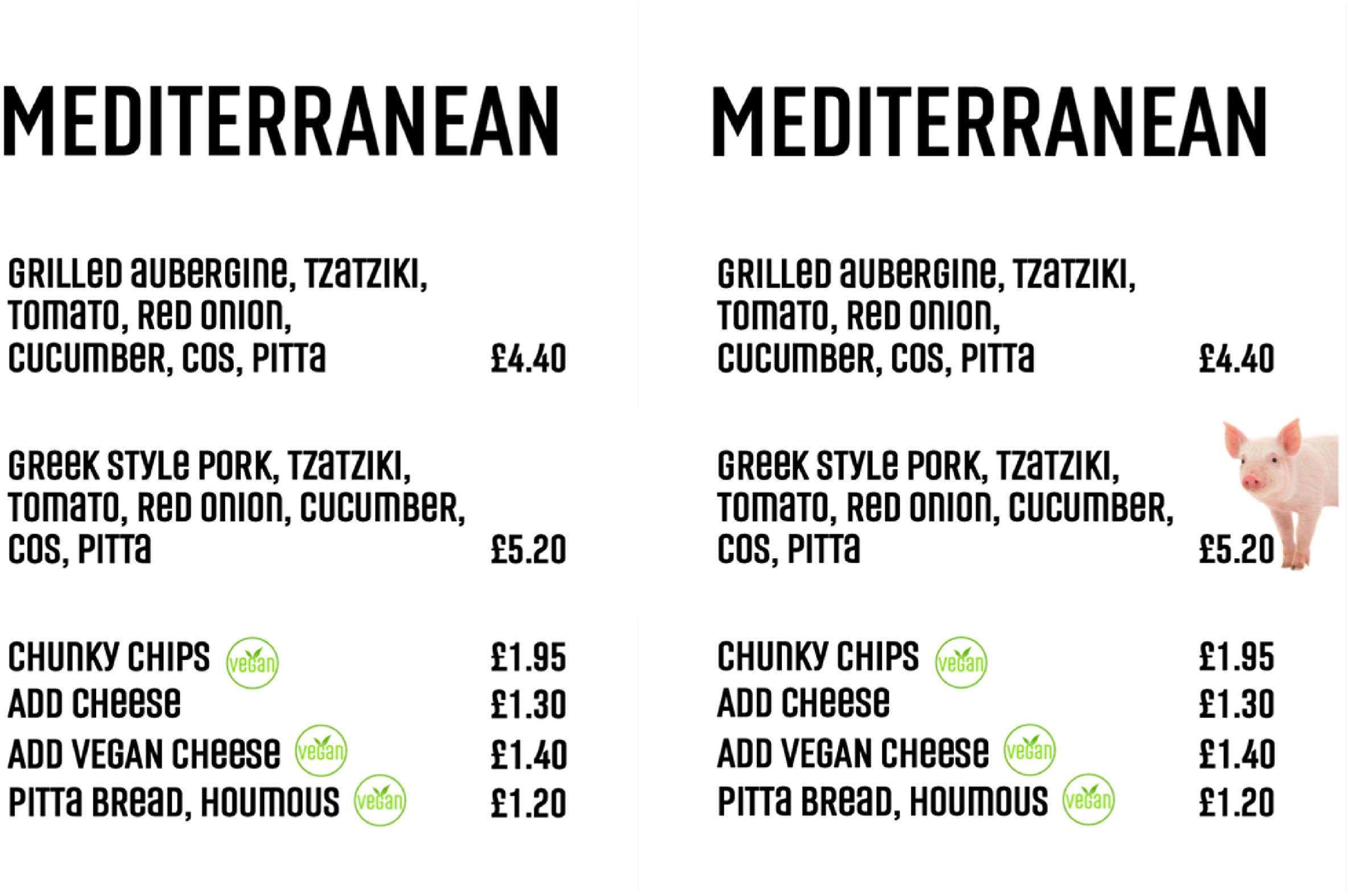
The experiment was simple. The researchers distributed two menus throughout a university cafeteria, identical in all but one respect: on one set, meat options were accompanied by an image of the animal involved. “For instance, an image of a chicken accompanied the sweet and sour chicken, an image of a pig accompanied the pork gyros, and an image of a cow accompanied the beef bolognese,” the paper explains. “No images were added next to the vegetarian dishes.”
These weren’t emotive images; there was no context given – just a pig, cow, fish, or chicken on a white background. But their effect was striking: the students who received a menu with an animal image were 22 percent more likely to order the vegetarian option over the meat. That was especially true for pigs, though not to an extent that’s statistically significant – agreeing with a more general trend in which people, it turns out, bloody love piggies.
Now, there are a few things to be aware of here. A study that takes place in a college cafeteria is not necessarily generalizable to a population that’s older, less educated, less (or more) affluent, and so on, and equally putting those images on a menu may not produce the same effect as having it on, say, a packet in the supermarket. The study doesn’t tell us whether it’s found a long-term or repeatable effect, either – only a one-off choice in a particular moment.
And it’s worth pointing out too that, while the likelihood change is notable, the overall increase in vegetarian meals was pretty small. That might not be a problem – “even small shifts can accumulate meaningfully at scale,” the authors point out, “for example, across multiple sites or with repeated exposure over time” – but it’s important nonetheless.
That’s because, despite the world’s ever-increasing meat intake, reducing the amount of animal flesh we eat is actually a high priority right now. Not only is it bad for us, but it’s bad for the world too. “Reducing meat consumption is widely recognized as one of the most effective actions for mitigating environmental impact,” the paper notes, with estimates placing the effects of a global shift to plant-based diets as “comparable to replacing fossil fuels with nuclear energy.”
What’s more, people generally want to not be eating animals. You only have to read the comments underneath any article that could be cast as promoting vegetarianism or veganism – this one included, most likely – to see how defensive people get about the idea that a pig died for their BLT, for example. There’s even a whole psychological effect named for the cognitive dissonance experienced by people who “love animals” but eat their flesh: the meat paradox.
With that in mind, an intervention like this – not preachy; not explicit; with no effect on consumer rights or financials – is needed now more than ever.
“While future research is needed to assess broader applicability, our findings demonstrate that visual cues reminding consumers of meat's animal origins can meaningfully influence real-world food choices,” the authors conclude, “and add to a toolkit of interventions aimed at encouraging more ethical and environmentally-sustainable food choices.”
The study is published in the Journal of Environmental Psychology.


 1
1