Technology
 PUBLISHED



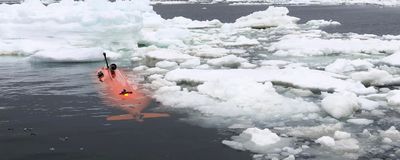


Two years ago, a robotic submersible ventured under the "Doomsday Glacier" in Antarctica and never returned, lost somewhere in the icy depths. It was a sad loss for polar research, but it hasn’t taken long to find a successor.
The rest of this article is behind a paywall. Please sign in or subscribe to access the full content.Ran was a 7.5-meter (25-foot) long, sausage-shaped autonomous underwater vehicle (AUV). Operated by the University of Gothenburg in Sweden, the luminously orange sub arrived in Antarctica in 2018 with the task of documenting the underwater environment using high-resolution acoustic sonar and other mapping instruments.
It was especially skilled at charting the underbelly of ice sheets, some hundreds of meters thick, that float on water around the continental edge of Antarctica. This is a critical task, as this is where warm water flows in and melts the ice from below. A clearer understanding of this process would help scientists better grasp the forces threatening to destabilize Antarctica's ice sheet.

Unfortunately, it was during one of these risky missions that Ran ran into trouble. In early February 2024, the sub was sent to document the underside of Thwaites Glacier in West Antarctica, known as the "Doomsday Glacier" for its potential to catastrophically raise sea levels if it collapses. However, after a long journey under the ice, it failed to resurface. Helicopters and drones were brought in to search the area, but their efforts were fruitless. Ran was lost forever.
“It's a bit like looking for a needle in a haystack, but without even knowing where the haystack is. At this point, Ran's batteries are dead. All we know is that something unexpected happened under the ice. We suspect it ran into trouble, and then something prevented it from getting out,” Professor Anna Wåhlin, an oceanographer at the University of Gothenburg and co-chair of the Southern Ocean Observing System, said at the time.
But the researchers didn’t mourn the loss for long. By October 2025, the University of Gothenburg bought a new high-tech sub from Kongsberg Discovery, a Norwegian company specializing in advanced marine robotics.
The newbie, dubbed Ran II, is set to be a similar model to its predecessor, but the team is loading it with extra precautions to prevent another loss.
“The new vehicle ‘Ran II’ will have better capacity than ‘Ran’, with more robust emergency decision support and improved navigation. These upgrades enhance both safety and precision in hard-to-reach environments such as beneath glaciers, sea ice, and near the seabed,” Stene Førsund, Executive Vice President for Sales and Marketing at Kongsberg Discovery, said in a statement.
The new sub is due to be delivered in the winter of 2026/2027, and its eventual launch can’t come soon enough. With global temperatures continuing to creep upwards, the need to gather data on Antarctica and its hulking ice sheets has never been more urgent.
“We are living in a time when the ocean needs our attention more than ever. The investment in Ran II, made possible with joint support from Voice of the Ocean and Eric Douglas, will give researchers access to a platform that can deepen our understanding of changes in the ocean and spread that knowledge further,” added Sanna Thimmig Johansen, CEO of Voice of the Ocean.