Nature
 PUBLISHED
 10
10


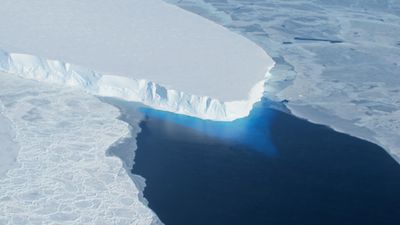


The “Doomsday Glacier” earned its nickname for a reason. Officially known as the Thwaites Glacier, this massive body of Antarctic ice is nearing a tipping point. If it entirely collapses, this single glacier alone could release enough water to raise global sea levels by 65 centimeters (over 2 feet), contributing to a catastrophe that would swamp coastal cities and swallow island nations. But one bold project has an extraordinarily ambitious solution to keep that threat at bay: building a giant sea curtain on the seafloor off Antarctica.
The rest of this article is behind a paywall. Please sign in or subscribe to access the full content.The scale of the construction would be colossal. To have a significant impact, the seabed barrier would need to stretch for over 80 kilometers (50 miles) and stand up to 150 meters (492 feet) high at a depth of 650 meters (2,132 feet). It would cost billions of dollars and would have to withstand conditions in one of the harshest environments on Earth.
For the Seabed Curtain Project, however, that is a challenge worth confronting.
“Just because it's extremely difficult is not an excuse not to try,” Marianne Hagen, co-lead of the Seabed Curtain Project, told IFLScience.
“For me, it's kind of a no-brainer. If it's possible to take 65 centimeters of global sea level rise off the table for everybody, with one single targeted intervention in one location, I'm willing to explore it. I think we have an obligation to do so,” said Hagen, who is also the former deputy minister of Foreign Affairs of Norway.
I truly believe that reducing emissions is what's going to save the planet. There is no way around it, with or without any climate interventions.
Marianne Hagen
This mammoth proposal is being put forward because the stakes are so high and, frankly, the situation’s outlook is bleak.
The Thwaites Glacier sits on the edge of the continental landmass of West Antarctica in an unclaimed region known as Marie Byrd Land. It’s roughly the size of the US state of Florida and is considered the widest glacier on Earth, with a breadth of around 120 kilometers (~80 miles). That represents an enormous volume of ice currently locked in solid form, which threatens to melt into water and flow into the ocean.
And the thawing is already underway. Driven by warming ocean temperatures, the volume of melted ice flowing into the sea from Thwaites and its neighbouring glaciers has more than doubled from the 1990s to the 2010s, accounting for 8 percent of the current rate of global sea level rise. Some, but not all, estimates suggest a full-scale collapse of the glacier may be coming in the next few decades, spelling potential catastrophe for millions upon millions of people.
“If you compare [the project costs] with the coastal repair and damage cost, it's a fraction. The cost of this project will run in billions. The cost of the damages will run into trillions,” she added.
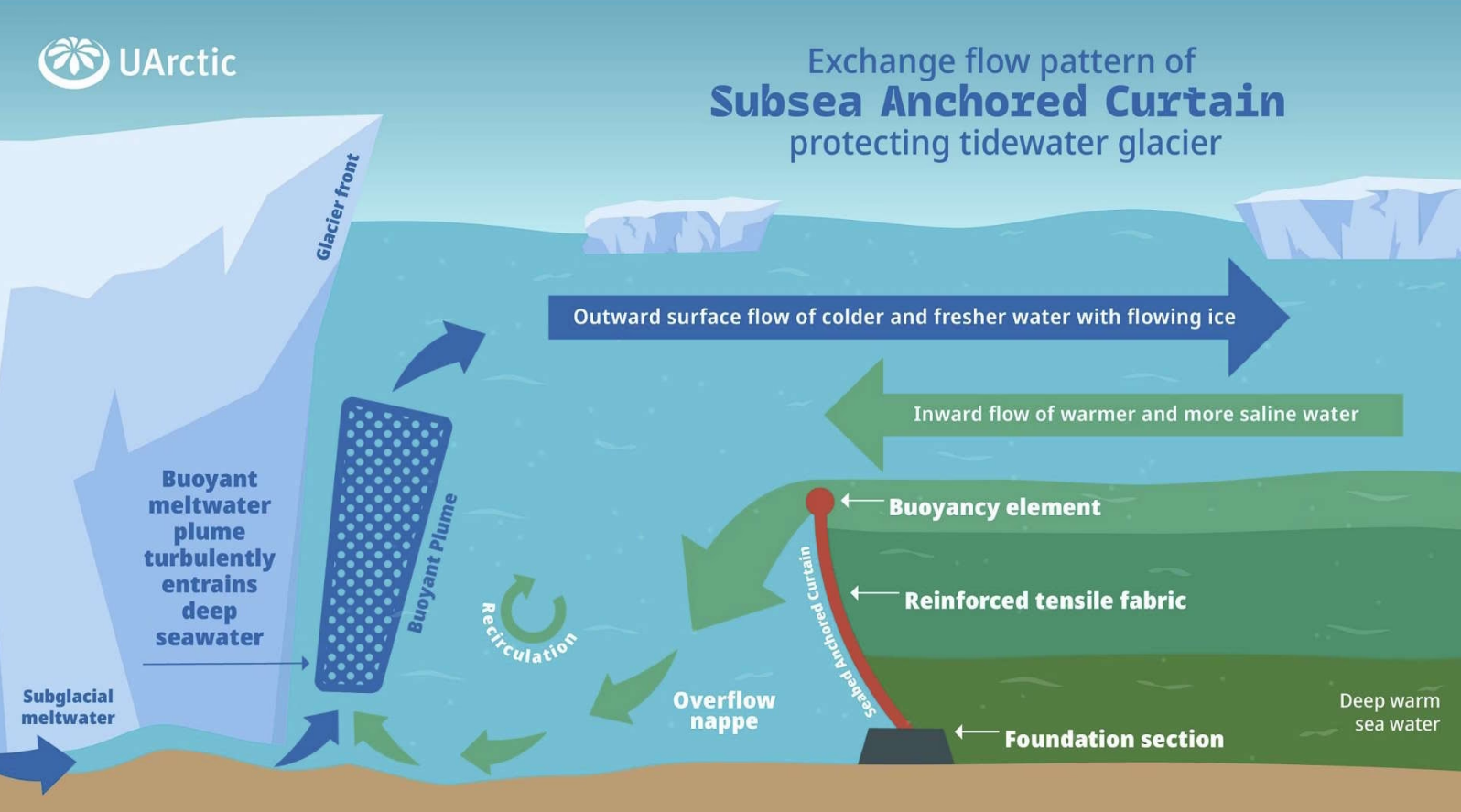
In recent years, scientists have identified what exactly is undermining the Thwaites glacier. A steady stream of increasingly warm water is creeping into a gap between the glacier and the continental shelf it lies on top of, effectively melting the ice from below.
The idea is that the sea curtain, anchored to the seabed, would reduce the flow of warm water to the most vulnerable parts of the glacier’s underbelly (see diagram above). One concept envisions a continuous barrier; another suggests several fragmented curtains, since a single, solid structure could experience too much drag from tidal forces and currents, behaving like an enormous underwater parachute.
The Seabed Curtain Project is still in its early days and many facets of the plan are yet to be fully explored. However, they’ve already assembled an international team of scientists, engineers, financial donors, and policy experts who are looking to tackle the challenge from all possible angles.
It would be absolutely insane, from an economic perspective, to go straight to Thwaites and start building something.
Marianne Hagen
One of its most intriguing research efforts, conducted in collaboration with other organizations, is focused on the Van Mijenfjorden in the Arctic archipelago of Svalbard. This fjord is a body of water that's naturally shielded by an island at its mouth, making it a useful real-world analog for studying how an artificial barrier might influence water temperatures, ice stability, and marine ecosystems in a polar setting.
In another project led by the Arctic University of Norway, a partner of the Seabed Curtain Project, a small-scale seabed barrier has been proposed in a northern Norwegian fjord. If it goes ahead, the site will serve as a testbed to see what might one day be attempted in Antarctica and elsewhere.
“It would be absolutely insane, from an economic perspective, to go straight to Thwaites and start building something. We need to test this at a much lower cost, in less harsh conditions,” said Hagen.
Along with the scientific and engineering hurdles, a seafloor curtain near Thwaites Glacier could raise a host of geopolitical concerns. Antarctica occupies a unique position in global politics as it is not governed by any single nation. It's managed through the Antarctic Treaty System, established in 1959 and signed by dozens of countries, which prohibits military activity and mining, while emphasizing international cooperation. Although Marie Byrd Land is technically an unclaimed region of the Antarctic, any attempt to build in its vicinity could be interpreted as a power move.
For this reason, research presented in 2024 argued that a large geoengineering megaproject in Antarctic waters has the potential to turn the southernmost continent into the “object of international discord.” Furthermore, the researchers suggested the structures could become a target for terrorism or armies wishing to upset global security. This, in effect, would spark the militarization of Antarctica.
All of these complex diplomatic concerns are delicate, under-charted waters that the Seabed Curtain Project will need to navigate carefully.
“This is a collaborative decision that has to be made by a lot of countries, and where people have to be very informed. The governance part is difficult – in times like this, more difficult than ever, in a way – but it has to be done the proper way. It has to be anchored within enough nations,” Hagen added.
It's important to highlight that any geoengineering project aimed at limiting the impacts of climate change must not be treated as a “get out of jail free” card for continued fossil fuel expansion – the world has not been handed permission to carry on with business as usual. As it stands today, more than 99 percent of scientists agree that greenhouse gas emissions are responsible for modern climate change. Reducing those emissions remains the most effective way to limit warming.
“I truly believe that reducing emissions is what's going to save the planet. There is no way around it, with or without any climate interventions,” said Hagen.
However, as we’ve seen in recent years, progress on this front is slow – and the clock is ticking. Faced with the very real possibility that climate change won’t be tackled hard enough, radical solutions like this seem less fantastical than they first appear.
Correction 13/2/26: Paragraph 14 has been amended to clarify that the seabed barrier construction in the Norwegian fjord is still currently in the planning stages, and there is not yet a concrete plan to deploy it.