Technology
 PUBLISHED
 1
1




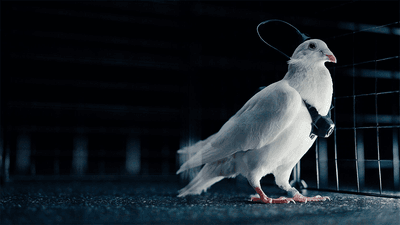


An international biotech company is claiming that they have created "bio-drones" after fitting pigeons with a brain-stimulating chip.
The rest of this article is behind a paywall. Please sign in or subscribe to access the full content.Pigeons have historically done a pretty good job of delivering messages for humanity. For instance, they hog the majority of the Dickin Medals, an award presented to animals for serving in a military conflict. Of the 75 animals presented with such a medal, 32 have been given to pigeons.
While impressive, the tech/biohacker world clearly thinks they could up their game a little.
Neiry, which describes itself as a "deeptech" company with offices in Dubai and Moscow, says that it has fitted birds with a microchip, a camera, a small controller, and solar panels mounted to their backs in order to keep the system online. During flights, the team says that the system delivers "mild stimulation" of the electrical variety, intended to guide the bird into preferring a particular, human-chosen direction. When not being stimulated, the birds behave "naturally", according to the company.
The birds can be seen in this demonstration. Skip to 1:13:00.
The team suggests that pigeons turned into "bio-drones" through minor surgery may be preferable to regular mechanical drones, though one might speculate they're speaking technologically rather than morally.
According to the team, pigeons are advantageous as they do not require battery swaps and can fly up to 400 kilometers (250 miles) in a day. They claim that the "drones" would be useful in search and rescue support, as well as monitoring remote areas, or conducting inspections on hard-to-reach infrastructure.
"Our current focus is pigeons, but different species may be used depending on the environment or payload,” Alexander Panov, founder of Neiry Group, added in a statement. “With the system ready for real-world deployment, this versatility becomes especially relevant in the scenarios where conventional drones face physical constraints."
The team claims to have an in-house bioethicist with whom they consult prior to these experiments, per Gizmodo. Other experiments by the company include fitting cows with neuro-stimulating chips in an attempt to increase milk yield. Another stunt saw a rat named Pythia fitted with a neuro-interface, before sending it on a stratospheric flight, for somewhat spurious reasons.
"Invasive neurointerfaces connected to AI will one day become indispensable assistants for humans. We believe they will first be used in the most responsible professions – such as pilots and astronauts. This means we need to begin testing these technologies right now," Panov said, justifying that stunt.
"Once we are certain that our technologies function reliably in the stratosphere, we’ll begin exploring whether the interaction between the biological brain and artificial intelligence can be utilized in space — to achieve types of neuroplasticity unattainable on Earth," Mikhail Lebedev, Professor at Moscow State University and Neiry consultant, added.
"For instance, Pythia might learn something new in zero gravity, leading to the formation of new neural representations and a retraining of the nervous system. This will allow us to understand how the nervous system can operate in space in synergy with AI. We will obtain valuable data that will form the basis for numerous scientific publications. In the future, systems that unite the biological brain and AI may be capable of solving complex tasks – including controlling spacecraft."
While it is unlikely that the pigeon drone idea will take off, this much we can say for certain; a lot of animals are getting minor surgery, taken up to the stratosphere, and their brains stimulated, for some very long-term and ethically dubious goals.