Nature
 PUBLISHED
 3
3




This article first appeared in Issue 18 of our digital magazine CURIOUS.
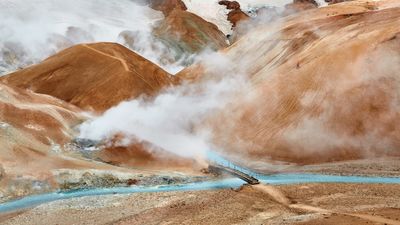
The rest of this article is behind a paywall. Please sign in or subscribe to access the full content.The hot springs in Fjallabak Nature Reserve, Iceland, are a tourist trap for adventurous humans looking to bask in the restorative warm waters and take in an unbeatable mountain view. However, as the BBC’s new three-part series Wild Scandinavia demonstrates, it’s also a popular spot among wolf spiders.
Reaching the Landmannalaugar Hot Springs is something of a quest in itself, requiring specialist vehicles that can handle the tricky off-road terrain. But succeed in making the journey and you’ll be rewarded with rich hues of yellow, green, and blue splashed across the mountains where lava, rich minerals, and moss have painted the landscape.
That is unless you’re traveling in the depths of winter. For episode producer Poppy Riddle and her team, the reward was capturing world-first footage of one of the region’s smallest of national treasures – but the season didn’t make it easy.
“The biggest problem we had was that the macro lenses would regularly fog up, particularly when we started filming each day because the glass was cold from our Arctic surroundings and hadn’t had a chance to reach the same ambient temperature as the air,” Riddle told IFLScience. “We’d have to keep a hawk eye on the spider for our cameraman, so that we could relocate our miniature star whenever the cameraman lost focus from the lens fogging up.”
Fortunately, the hassle paid off.

“Once I had seen them, I couldn’t unsee them – they were everywhere, coating every strand of moss in a thick mat all around us,” Riddle said in a release. “I lifted up one of the mineral-stained rocks and five spiders ran out in different directions towards the clusters of tiny black flies that I had also managed to miss… but I had my eye in now, and it seemed as if the ground was heaving with spiders.”
If soaking among the “Laugakönguló” wolf spiders (Pirata piraticus) isn’t action enough, Landmannalaugar also boasts several hiking trails that weave through the Fjallabak reserve. As a geothermally active region, the trails are rich in hot springs, rivers, and steam vents nestled among the colorful mountains. However, not every spring is safe, so for the most relaxing steam experience be sure to check with a guide – or you can always follow the spiders…
How to get there: Landmannalaugar can be visited as part of a day trip or by those with suitable vehicles for the tricky terrain. Alternatively, you can explore the springs and Wild Scandinavia from your sofa over on BBC iPlayer.
CURIOUS magazine is a digital magazine from IFLScience featuring interviews, experts, deep dives, fun facts, news, book excerpts, and much more. Issue 21 is out now.