Space and Physics
 PUBLISHED


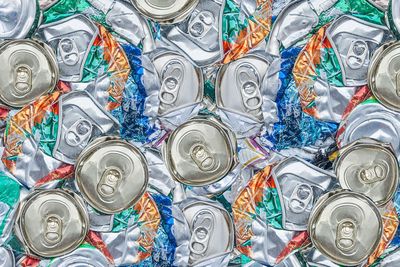


As terrible a place as the internet can be, there are undeniable bright spots too. The cat videos, for one. Rickrolling. Those weirdly satisfying ASMR rug cleaning compilations. Salad fingers. And, of course, the hydraulic press videos. You just can’t beat watching an empty soda can, or a full one, getting slowly crushed into a tiny silver pancake – but have you ever watched both and wondered why they react so differently to the pressure? Researchers at the UK’s University of Manchester did – but unlike you and us, they actually figured out the reason.
The rest of this article is behind a paywall. Please sign in or subscribe to access the full content.“Most of us have stamped on an empty can and watched it collapse instantly,” said Shresht Jain, a PhD researcher at the University of Manchester and lead researcher on the project, in a statement. “But a full can behaves completely differently.”
“It forms one buckle after another in an orderly fashion, until the whole can is wrapped in evenly spaced corrugations,” Jain explained. “We were fascinated and wanted to understand what was driving that behaviour – particularly as liquid-filled containers are found everywhere in our day-to-day lives.”
So, what’s the best way to find out how and why a can buckles the way it does? Why, to crush it yourself, of course! The team collected a variety of beverage cans of various sizes and, well, smunched ‘em, recording each round for upload to a mathematical processing program. They coupled these experiments with abstract mathematical modeling, working out the theory that would explain precisely what they were seeing.
They found that cans filled with liquid – whether that be soda, held in at two to four atmospheres of pressure, or with water held in at one atmosphere – all follow a predictable pattern of crunch.
“A standard can usually starts to buckle near the middle,” explained Dr Draga Pihler-Puzovic, Reader in Nonlinear Dynamics at Manchester and coauthor of the paper. “Tiny variations in shape or size of the can can shift where the first ring appears. After that, however, the physics takes over, and the sequence becomes extremely predictable.”
“Even changes in the can’s internal pressure don’t alter the overall pattern much,” Pihler-Puzovic continued. “That tells us that the buckling sequence is a fundamental property of any liquid-filled cylinder made from metal, not just a quirky effect of a drinks can.”
So, case closed – but as it turned out, this investigation turned up more than just a nice explanation of how filled cans buckle. “As the can compresses, the metal softens and then stiffens again,” Pihler-Puzovic explained – a process known as homoclinic snaking, in which a system slides, Jacob’s ladder-style, from one almost-stable state to another. “This cycle naturally forms the rings,” said Pihler-Puzovic.
Mathematicians and engineers had long suspected that snaking drives various physical phenomena like this – but actually proving it has been elusive. It’s hard to catch on camera or trace its progression directly. To have confirmation of the process is hugely valuable, therefore, providing an answer not just to a fun attention sink, but also to real and important open questions in engineering.
“Understanding the exact sequence of buckles could help engineers spot the early warning signs of failure long before a system collapses,” said Dr Finn Box, a Royal Society University Research Fellow in the University of Manchester’s Center for Nonlinear Dynamics and coauthor of the paper. “It might even open up possibilities for manufacturing. For example, it could be possible to create corrugated cans after filling without needing a mould.”
“[It] could lead to safer designs, better monitoring techniques, and more reliable structures in a whole range of industries.”
The paper is published in the journal Communications Physics.



 1
1