Humans
 PUBLISHED


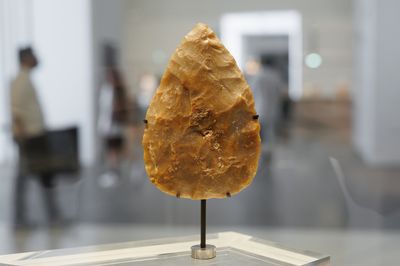


A little under two million years ago, a prehistoric hominin in Africa made a cognitive leap that enabled it to produce a type of stone tool that was far superior than anything that had come before. Known as the Acheulean technocomplex, this primordial culture later spread across Europe and Asia, where it remained the dominant industry for around 1.75 million years.
The rest of this article is behind a paywall. Please sign in or subscribe to access the full content.However, despite being the longest cultural period in the history of the Homo lineage, many fundamental questions about the Acheulean remain unanswered. Grappling with these uncertainties, a group of 20 researchers from around the world recently met at Musée de l'Homme in Paris to discuss the meaning of the word “Acheulean” and the many ways in which this technology is represented at archaeological sites across the planet.
Summarizing their roundtable discussions in a new study, the researchers note that the definition of the Acheulean industry remains somewhat murky. Named after the French site of Saint-Acheul – where archaeologist Gabriel de Mortillet first described the technocomplex in 1872 – the Acheulean was initially associated with the presence of large handaxes.
Still considered the hallmark of the Acheulean, these ancient handaxes are classed as “bifaces”, meaning they are flaked on both sides to create a sharp, symmetrical cutting tool. As such, they represent a massive improvement on older technologies like the Oldowan toolkit, which generally consists of stone cores with flakes removed from part of the surface in order to create an edge.
As such, the emergence of the Acheulean is seen as a major technological transition that differentiates the earliest members of the genus Homo from later, more advanced species. However, the study authors suggest that the Acheulean involves far more than just handaxes, and is in fact defined by a suite of cognitive abilities and cultural behaviors.
“Our definition of the Acheulean should not be reduced to a simple presence/absence of handaxes in the lithic assemblages,” they write. “We argue that the Acheulean is best understood as a broad technocomplex of technological behaviors that distinguish it from the preceding Oldowan, which marks a cognitive leap.”
“These include the ability to produce large flakes and further shaping them into preconceived standardized tools, fragmented reduction sequences, and the hierarchical organization of knapping,” continue the researchers.
They therefore suggest that the presence of large cutting tools like handaxes and cleavers are merely “the most visible manifestation of these behaviors,” although the cognitive underpinnings of the Acheulean may have also been linked to specialized hunting practices and the ability to make fire.
Given that the Acheulean persisted for such a long time and was adopted across Africa and Eurasia, though, the researchers present at the roundtable unanimously agreed that our understanding of human evolution remains too fragmented to pinpoint which members of the Homo lineage invented or used this technocomplex. After all, Acheulean tools have been found in regions occupied at different times by Homo erectus, Homo ergaster, Homo antecessor, Homo longi, Neanderthals and modern humans – to name just a few of the potential candidates.
What we do know is that the Acheulean probably emerged in East Africa, although it’s unclear which hominin developed it or introduced it to Eurasia. This picture is muddied further by the fact that these tools appear in the Middle East and India by about 1.7 million years ago, but don’t show up in Europe until almost a million years later.
In Spain, for instance, a few Acheulean handaxes have been dated to about 900,000 years ago, although another 400,000 years would pass before these utensils became common in Western Europe. Previous research has indicated that a possible “second wave” of the Acheulean may have spread through the UK half a million years ago, at which point handaxes became considerably more symmetrical and refined.
These upgraded tools are speculated to have been the work of some sort of pre-Neanderthal hominin, although more work is needed to identify the author.
The study is published in the journal Evolutionary Anthropology.