Space and Physics
 PUBLISHED
 1
1






Time is relative. This physical truth is mostly lost on us, who live our lives in the world of classical physics. flows more quickly on top of a mountain and more slowly if you are going fast, we don't generally experience this ourselves.
The rest of this article is behind a paywall. Please sign in or subscribe to access the full content.On top of that, the ways we measure time leave a lot to be desired. If I point at an object on Earth, I can say it was made at 11:00 am UTC on January 1, 2026, which is a very specific time coordinate. But the seconds depend on a completely arbitrary definition, the date depends on the rotation of our little planet, and the year depends on its revolution around the Sun. If we were to find aliens, they wouldn't know what we mean.
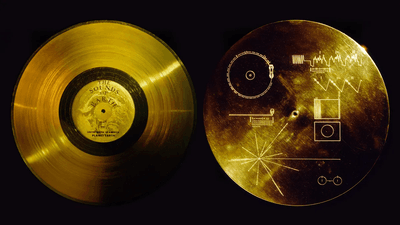
This might not seem like a particularly important problem, but the team working on the Golden Records housed in NASA's Voyager spacecraft thought differently. Voyager 1 and Voyager 2 have been traveling across the Solar System, and now beyond it, for almost 50 years. They first explored the gas giants before crossing into interstellar space, and each was given a golden record filled with images and sounds from planet Earth.
Let’s just say it is extremely unlikely that another civilization will find these spacecraft. It will take hundreds of thousands of years before they pass "near" another star, and space is mindbogglingly big. And even if they were to happen across the probes, finding a way for aliens to discover where and when they were made is not easy.
The team couldn’t just slap on a label that said "Made on Earth in August 1977". Well, they could have, but that wouldn’t mean much to Mx. J. Alien of Rho Ophiuchi 6. To provide a location, the records' covers show a map of pulsars. Pulsars are exceptional clocks, pumping out radio waves with a very specific beat. The problem is that things change, especially over vast timescales. The pulsation will eventually change, their relative position to the Solar System will change, so this more of a vague address than a clear map.
In terms of when the records were made, though, we are doing better. They are constructed of gold-plated copper. Gold is known for its resistance to rust and corrosion, not that those are the main concerns in interstellar space. And assuming that cosmic rays from the rest of the galaxy don't affect the metal too much, the records have a special secret to confirm when they were sent.
The record covers are made of aluminum, and electroplated upon them is a sample of uranium-238. The sample is ultrapure, and the radioactive element has a half-life of 4.46 billion years. This means that in about 4.5 billion years, only half of the original sample will remain. By studying how much or how little uranium is left, alien scientists would be able to estimate how long it has been since the record was manufactured, even if they were to find it many billions of years in the future.
Voyager 1 and 2 are now almost one light-day away from Earth, with Voyager 1 set to cross that threshold in November. That’s an enormous distance by human standards – in fact, the Voyager probes are the most distant human-made objects – and yet it is a tiny distance when it comes to the galaxy. It is very unlikely that other species will come across our little messengers, but if they do, they will hear Earth’s sounds, see some images of our planet, and learn how long ago the record was made.
“This is a present from a small, distant world, a token of our sounds, our science, our images, our music, our thoughts and our feelings. We are attempting to survive our time so we may live into yours,” reads the written message by the late President Jimmy Carter on the records.
The Golden Records remain wonderful messages to whomever might be out there, and their creators did well to consider the challenges of making ourselves known. Ultimately, though, these records are about us humans; they are mirrors to what we could be, what we might be, and what we should be. After all, the record inscription reads: To the makers of music – all worlds, all times.