Nature
 PUBLISHED



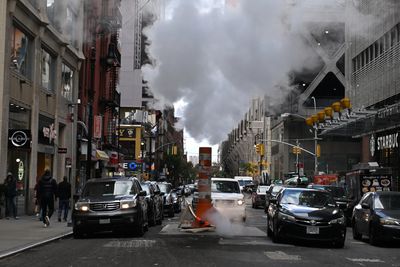


Since the 1990s, the US has caused over $10 trillion in global economic damages, according to a new analysis from Stanford University. The study also shows that although carbon dioxide emitted over the past three decades ago has already caused significant problems, it is exceeded by the economic damage that is yet to come.
The rest of this article is behind a paywall. Please sign in or subscribe to access the full content.Among the costs imposed by the US’s emissions, the new study suggests, are large-scale damages to developing economies. This includes $330 billion in Brazil and $500 billion in India.
But the US has also been the victim of its own emissions, with nearly $3 trillion, or roughly a third of their overall damages, falling within the United States itself.
“It turns out U.S. emissions have really hurt U.S. output,” Marshall Burke, a professor of environmental social sciences at the Stanford Doerr School of Sustainability explained in a statement.
Decades of scientific research has established that human activity is changing Earth’s climate and these changes are having disproportionate and negative impacts on different regions and people. In particular, it has become clear that those who are experiencing the most harm have actually contributed a small fraction to historical emissions.
As such, there are increasing calls for emitters to be held accountable for what’s referred to as “loss and damage”. This is the conceptual name for the cost of impacts from climate change that countries can’t prevent by cutting emissions or avoid by adaptation. Litigation against major emitters for climate-related loss and damage is now an emerging field, with some high-profile lawsuits having taken place in recent years, while others are still ongoing.
But despite these efforts to link damages to specific emissions, there is no real definition or even agreed upon framework to link historical and future emissions to specific sources with a monetized cost. With this in mind, Burke and colleagues set about creating a new framework for calculating “loss and damage”.
"We typically think about dealing with climate change in two ways, either mitigating climate change—so, slowing and stopping climate change—or adapting to its impacts. Confronting the damage that occurs when mitigation and adaptation fall short is the third leg of the stool that we just don't talk about that much," Burke explained in a statement.
Burke and colleagues treat greenhouse gases like household garbage collecting industries where the costs of unpaid garbage bills are the equivalent to “loss and damage”.
“When we generate garbage, it’s illegal to dump it wherever we want, because doing so creates a cost to others,” Solomon Hsiang, a professor of environmental social sciences in the Doerr School of Sustainability added. “Normally, we pay someone else to take our waste away. Our legacy of greenhouse gas emissions is similar, except we’ve never paid the bill and it just keeps accruing interest.”
There are a few ways to address this climate bill. Removing carbon dioxide and other greenhouse gases from the atmosphere will lower it. New scalable technologies for greenhouse gas removal are being developed, but the timing of their deployment is critical. For instance, the team calculates that, if a ton of carbon dioxide stays in the atmosphere for a quarter of a century before it is removed, half the damage expected from that ton has already been inflicted.
“Our study shows that because of the compounding impacts of warming on economic growth, the time since the emissions occurred is critical for accurately accounting for the loss and damage associated with past emissions, as well as the cost-benefit analysis of potential solutions,” explained Noah Diffenbaugh, also at Stanford.
In 2023, the team released a preprint of this study with lower overall damage estimates. However, since then, they have accounted for more delayed effects of warming on economic output.
"We see in the data that the effects of a really hot year can persist for a long time," Burke added. "When you include the long-run effects, the damage estimates get bigger."
For instance, the study found that emissions between 1988 and 2015 tied to the production and use of oil by Saudi Aramco, the world’s largest corporate emitter, came to $3 trillion in global damages by 2020. If those emissions stayed in the atmosphere until the end of the century, the damage could rise to over $64 trillion – over a 20-fold increase.
"As long as a ton of emitted carbon dioxide is up there, it is causing warming and that warming is causing damage," said Burke.
This new framework provides a sound basis for considering loss and damage, but it has some challenges. Firstly, applying it will require specific judgement calls, including how to discount past and future damages and how much responsibility to assign for emissions from production or consumption of fuels such as oil and gas.
There is also an important legal and ethical question to be considered when it comes to determining which year is reasonable to assign responsibility for emissions and damages. In this study, the team started with 1990, which was around the time when the UN almost adopted its first global climate treaty with the aim of limiting warming and damages.
Although the research provides a sobering cost for the US’s historical damages, the team believes the actual damages likely exceed their estimates. This is because the analysis reflects the impacts of warming on aggregate economic growth without accounting for other harms.
"We haven't accounted for impacts that aren't captured in GDP, such as loss of biodiversity and cultural homeland, and our approach also underweights some sources of climate impacts such as sea level rise and some types of extreme events," Diffenbaugh explained.
"This makes our estimates conservative."
The paper is published in Nature.