Humans
 PUBLISHED



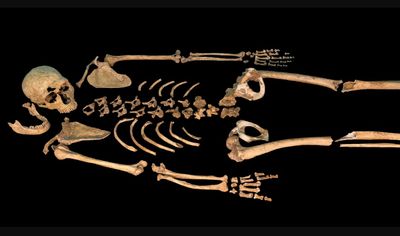


Some of the last Neanderthals ever to walk the face of the earth may have faded into extinction with proper funerals. First discovered at the iconic La Ferrassie site in southwest France in 1909, this group of late Neanderthals consists of eight individuals – including adults, children, babies and fetuses – some of whom appear to have been intentionally buried.
The rest of this article is behind a paywall. Please sign in or subscribe to access the full content.Previous research has focused on the remains of a 2-year-old Neanderthal child who died at La Ferrassie around 40,000 years ago. For decades, researchers argued over whether the body had been deliberately interred or had simply ended up that way due to the natural build-up of sediment. In recent years, however, it has become increasingly clear that the toddler – known as La Ferrassie 8 – was purposely laid to rest in a dug pit, with its head to the east and pelvis to the west.
This same orientation has been noted for several other skeletons found at the site, although it remains less certain whether these cases were intentional or coincidental. Among those to have spent the last few dozen millennia in this position is the famous La Ferrassie 1 specimen, which is among the most complete Neanderthal skeletons ever found and is believed to have belonged to an adult male.
Original attempts to radiocarbon date La Ferrassie 1’s bones proved tricky, leading to a somewhat imprecise age range of 32,000 to 52,000 years. If its real age lies somewhere towards the edges of this range, that would put it in a different cultural context to La Ferrassie 8, making it less likely that the adult male skeleton was buried intentionally. To narrow this down, the authors of a new study conducted radiocarbon dating on six animal bones that were found in the same sediment layer as La Ferrassie 1, all of which had been stored at the Musée de l’Homme in Paris for decades.
Results indicate that these faunal remains are between 42,610 and 39,830 years old, suggesting that La Ferrassie 1 and La Ferrassie 8 lived at roughly the same time. While this doesn’t prove that the adult male was intentionally buried, it does reveal that these individuals belonged to the same techno-cultural complex and may therefore have been subjected to the same funerary practices.
Known as the Châtelperronian industry, this culture is exclusively associated with the Neanderthals that occupied Western Europe between 45,000 and 40,000 years ago, ending with the extinction of the species. Notably, the strongest evidence for Neanderthal burials is found in Châtelperronian contexts.
Having said that, the oldest signs of Neanderthal funerals actually come from the Middle East, where these extinct hominins may have begun burying their dead more than 100,000 years ago. In Europe, however, such practices don’t seem to have taken hold until the final throes of the Neanderthal era.
The findings of this new study help to shed new light on the emergence of this behavior in the last Neanderthal stronghold, indicating that at Le Ferrassie, individuals of all ages may have been afforded similar burials.
The study has been published in the Journal of Archaeological Science.