Nature
 PUBLISHED




At IFLScience we don’t like to judge animals through the lens of beauty. To you, a purple frog might look like a raw burger patty, but its conspecifics celebrate that fleshy-slab physique for what it's capable of (spending an extraordinary amount of time underground).
The rest of this article is behind a paywall. Please sign in or subscribe to access the full content.They use their radula and an acid secretion to bore holes into the shells of bivalves and other snails.
Paul Clarkson
Animals are not beautiful or ugly. They are exquisitely adapted to their environment. That said, I really think we need to talk about the moon snail.
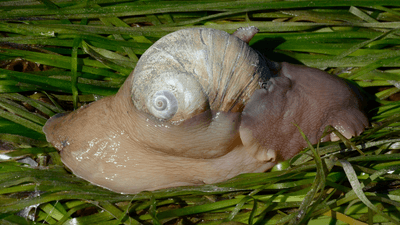
Lewis’ moon snail, to be precise. Known to science as Neverita lewisii, and to my eyeballs as quite an assault.
Words that might come to mind upon seeing a Lewis’ moon snail for the first time include “puddle”, “mess”, and – dare I say it? – “phlegm”. It can be seen glooping out of its shell to such a size it’s hard to fathom how it ever fit inside. Hardly a body form that we small-minded humans would consider athletic, and yet these creatures are voracious hunters.
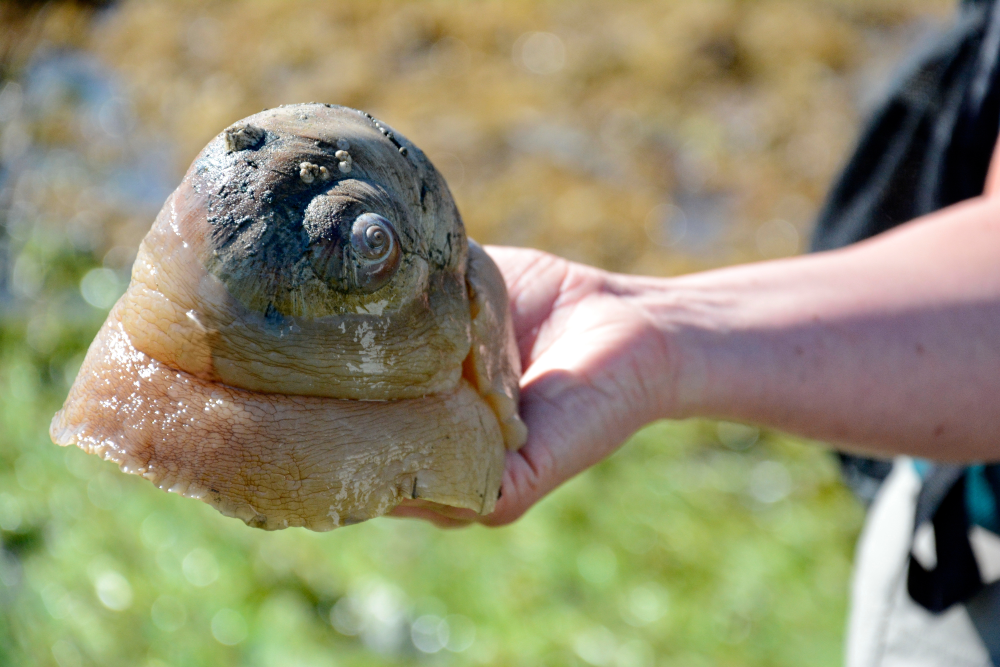
“Moon snails are predators of other mollusks,” said Monterey Bay Aquarium Director of Husbandry Operations Paul Clarkson to IFLScience. “The foot is used mostly for locomotion, [but] it is also used to surround and engulf prey items while the moon snail drills into the prey’s shell.”
“They use their radula and an acid secretion to bore holes into the shells of bivalves and other snails. Once the hole is drilled, their proboscis goes through the hole to consume the animal living in the shell.”
National Geographic photographer Joel Sartore recently visited the Monterey Bay Aquarium to photograph the Lewis’ Moon Snail for his Photo Ark project, which he describes as “a groundbreaking effort to document species before they disappear – and to get people to care while there’s still time.”
Whatever your thoughts on amorphous blobs, the Lewis’ moon snail is as worthy an addition as any cute, fluffy monkey because they play a key ecological role. As specialized predators, they maintain balance within their ecosystem and influence the structure of the seafloor community.
Moon snails are ecosystem engineers, helping to aerate the sediment by redistributing layers and fertilizing the landscape with shell fragments and other excretions. They’re also a food source for lots of larger animals, and then there’s the incredibly cool thing they do with their eggs.
You could be forgiven for thinking you’d found a random bit of pottery on the sand when encountering moon snail eggs, which are laid in a sand collar. These can be 30 centimeters (1 foot) wide and, despite their impressive structural integrity, are crafted from just eggs, mucus, and sand.
The gelatinous mucous helps keep the eggs moist, even if the collar is exposed to air in the surf. The sand grains help camouflage the eggs.
Paul Clarkson
“The sand collar is formed from a mucus capsule that the snail lays around its body, hence the circular shape,” said Clarkson. “The hole in the collar can provide an estimate of how large the snail’s shell was that laid it.”
“That mucus capsule glues sand grains together, then the eggs are laid on the collar and sealed in with more mucus and sand. This matrix helps protect the eggs until they’re ready to hatch. The gelatinous mucus helps keep the eggs moist, even if the collar is exposed to air in the surf. The sand grains help camouflage the eggs and deter predators.”
So, blob-like or not, we salute you, Lewis’ moon snail. Now please, show us how you fit back inside that shell.