Nature
 PUBLISHED



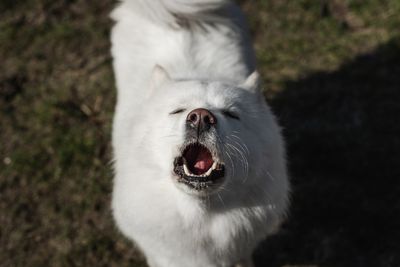


Does your dog howl like a wolf? This question inspired a group of researchers to learn whether dog breeds can regulate the pitch of their howls in a similar manner to the wolves they are descended from.
The rest of this article is behind a paywall. Please sign in or subscribe to access the full content.Finding out would involve crowdsourcing some dogs, so the researchers asked owners of ancient dog breeds to participate if their dog was known to howl along to songs or sirens. The team took recordings of the howl-inducing audio and moved them up and down in pitch by 3 semitones. They then asked the participants to film their dogs howling along to the original, as well as the versions that had been shifted up or down in pitch. The dogs in the study were always free to leave the room at any stage of the recording.
Four Samoyeds and two Shiba Inus met the criteria for the study. The team measured three acoustic features for each howl, including duration, mean frequency, and spectral centroid, a measure used in digital signal processing to work out where the “center of mass” of a sound is located and where the signal's power is coming from. By using all three features the researchers could see whether the dogs changed their howl pitch, amplitude, or both in response to the recording changing pitch.
Three of the four Samoyeds howled along to songs with vocals, “Believer” by Imagine Dragons, “Shallow” by Lady Gaga and Bradley Cooper, and “Grapevine” by Tiësto. These dogs could change their pitch but not their spectral centroid, while the other Samoyed, Alfie, who howled along to “Let the Bright Seraphim” by G. F. Handel, changed both his pitch and spectral centroid.
Neither of the Shibas changed pitch, but one increased its spectral centroid, while neither the Shibas nor the Samoyeds changed their howl duration during the experiments.
The findings show “that flexible control of voice pitch can evolve independently of complex vocal learning in mammals in the context of simultaneous group vocalization”, explain the authors.
Humans can do this kind of thing even without vocal training, and the study shows the same ability is present in these dogs. In the wild, wolves alter the pitch of their howls when howling as a group, perhaps to make the groups seem larger and stronger. At least in these relatively closely related ancient dog breeds, it seems the skill hasn't been lost.
The paper is published in Current Biology.