Nature




Physics is a harsh mistress. It’s thanks to her that we can’t fly; we can’t pop into a black hole to see what’s on the other side; and as much as we might want to, we can’t create kaiju-level monsters to wreak havoc upon our various metropoles.
The rest of this article is behind a paywall. Please sign in or subscribe to access the full content.Why? Well, in the latter case at least, because of the cube-square law: the dimensional rule that says volume must increase at a faster rate than area, which in turn increases faster than length or height. Thanks to this, Godzilla is an impossibility – there’s just no way to increase the volume of a beast that far and have the muscle and bone strength keep up.
But! There’s a flipside to the Godzilla problem, and it’s this: if you get small enough, you start to run into the same problems.
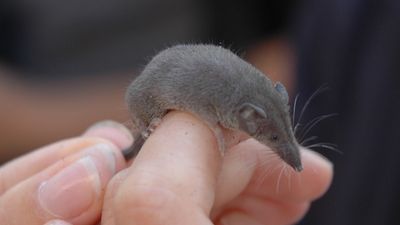
Meet the Etruscan shrew (Suncus etruscus).
With an average weight of 1.8 grams – that’s 0.063 ounces, or about as heavy as a single playing card – this little critter is the smallest known extant mammal by mass. It’s only a touch larger than the smallest known mammal ever. And that’s not a coincidence.
Here’s the thing: there’s a limit on how small mammals in particular can get. We’re not sure exactly what that limit is, but at 1.3 grams (0.046 ounces), the long-extinct Batodonoides vanhouteni is thought to be basically it.
“The tiny Batodonoides was operating near the minimum size limit imposed by mammalian physiology,” confirmed Paul David Polly, a vertebrate paleontologist at Indiana University-Bloomington and a Research Associate at the Field Museum in Chicago, in an explainer for Britannica. “At this size, animals are hard-pressed to gather food fast enough to maintain a constant body temperature.”
The reason for that is our good friend the cube-square law. See, a creature’s ability to lose heat is tied to its surface area, which changes an order of magnitude slower than volume. For unreasonably huge creatures, this means that they can’t get rid of heat fast enough: assuming they didn’t die first of asphyxiation or compression or good old inertia, any kaiju out there would rapidly die from heat exhaustion instead.
But for very, very small critters, the opposite is true. If you scale, say, a cat down to 0.1 percent of its volume – the resulting kitty would be just a bit more than three times the weight of the Etruscan shrew, for reference – its surface area is only reduced by a factor of 100. In other words, the surface area-to-volume ratio in the smaller cat is ten times larger than the regular cat’s.
Unfortunately for our mini-cat, an organism’s metabolic rate scales with body mass – the thing that’s now much tinier than the metric that cancels it out. As a result, very tiny animals lose heat at a rapid pace – and, past a certain point, that’s just unsustainable.
Example: our Etruscan shrew. Press a tiny stethoscope to its chest, and you won’t be able to discern a heartbeat – not because it’s absent, but because, at 25 beats per second, it’s so incredibly fast that all you’ll hear is a hum. The shrew has to eat constantly just to stay alive – they “must feed up to 25 times per day, with daily consumption of more than their body weight in food,” notes one 2022 paper on the critters’ upkeep – and if it goes without food for just four hours, it literally starves to death. It consumes up to 250 times the amount of oxygen per kilogram of body weight as we do, and if it starts to get even a little cold, it enters a mini-hibernatory state of torpor.
It's pretty much the definition of life on the edge, and it’s only because the species is frankly incredible at reproduction that it survives at all. But that’s what you get when you push the boundaries of physics – you can’t argue with math, no matter how big (or small, or good at making babies) you are.