Space and Physics
 PUBLISHED





Researchers from the University of Vienna have reported quantum interference in metallic nanoparticles. These little spheres were made of between 5,000 and 10,000 sodium atoms and measured about 8 nanometers in diameter. They are still tiny objects, but they have become the biggest bodies to have been placed into a quantum state.
The rest of this article is behind a paywall. Please sign in or subscribe to access the full content.The particles have roughly half the diameter of the average virus, but being dense metallic spheres, they are more massive than most proteins in our body. The experimental setup was designed to test interference, such as the double slit experiment, to confirm the dual particle and wave nature of these objects.
We mostly know interference from lights or in water. As flat waves pass through openings, they curve and can interfere, creating distinct patterns. This was crucial proof that light was a wave. Light is also made of particles, of photons. Then, quantum mechanics proved that when we consider particles, such as electrons, they also behave like waves. This duality of nature exists everywhere. Even we humans have a wavelength.
.jpg "the double slit expeirment see a wave approaching a board with two slits in it. Thewave passes through the two slits creating interference fringes. On a wall, the interference pattern emerges with a strong clear image in the middle and weaker smaller further and further from the center")
Macroscopic objects, including us, do not normally experience the quantum mechanical properties. This is due to quantum decoherence and the large number of particles involved. Basically, at our level, there is too much chaos, and the quantum properties – which are fragile – collapse, and it all averages out to what we experience.
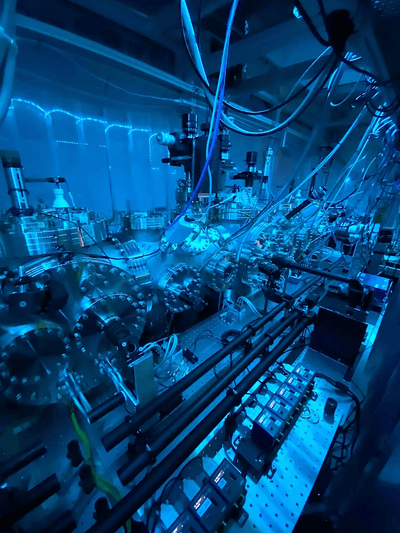
That said, it is possible under laboratory conditions to demonstrate the quantum properties of macroscopic objects. The team used three ultraviolet light gratings to act as a beam splitter and a phase grating normally used in interference experiments. They were able to have the sodium nanoparticles produce the interference pattern at the end of the setup, just like light or electrons would.
The particles were shown to be both “here and there” at the same time; the experiment pushes the limit of “macroscopicity” by almost 10 times. This put some stringent limits on alternatives to quantum theories.
“Intuitively, one would expect such a large lump of metal to behave like a classical particle,” lead author and doctoral student Sebastian Pedalino said in a statement. “The fact that it still interferes shows that quantum mechanics is valid even on this scale and does not require alternative models.”
Application of quantum properties has been part of our technology for decades, and they are found in the very devices you might be using to read this article. Still, there is a growing interest in further expanding the use of quantum properties to develop more precise sensors.
The team aims to push macroscopicity even higher, planning to beat their own record by hundreds of times.
The study is published in the journal Nature.



 1
1