Nature
 PUBLISHED


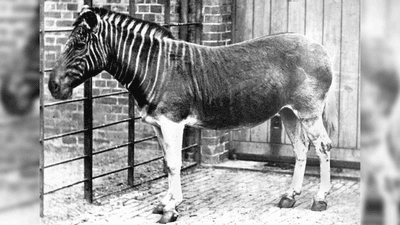


When it comes to striped four-legged equids, South Africa is a one-horse town. But this wasn’t always the case. If you visit the country today, you may have the pleasure of seeing different species of zebra roaming the plains, but had you visited before the late 19th century, you may have also seen another now extinct horse-like animal – only this one had fewer stripes.
The rest of this article is behind a paywall. Please sign in or subscribe to access the full content.The quagga (Equus quagga quagga) was a type of zebra in South Africa with strong brown stripes on its head and neck that gradually faded from there. This meant, from the shoulders to the rear, the quagga looked more like a horse.
These large herbivores were once abundant in South Africa, which was also home to various species of zebra, some of which are still alive today – such as the plains zebra (Equus quagga), some members of a plains subspecies called Burchell's zebra (Equus quagga antiquorum), and the Hartmann’s mountain zebra (Equus zebra hartmannae) that ranged into the country. However, during the 19th century, the quagga intensely hunted for its meat and hide, while others wanted to eliminate it to protect their crops.
As such, by the end of the century the species was extinct. The last wild quagga is thought to have died in the late 1870s, and the last captive specimen died on August 12, 1883, at Artis Zoo in Amsterdam.
From the late 1700s onwards, the quagga was believed to be a distinct species, but DNA analysis carried out in 1984 demonstrated that it was actually a subspecies of the plains zebra. This research was carried out by researchers at the University of California and San Diego Zoo using genetic material taken from a piece of dried quagga muscle tissue that was being held at a museum.
This research was significant for two reasons; firstly, it revealed the quagga's status as a subspecies. Secondly, it secured the role of the quagga as being the first extinct animal to have its DNA analyzed.
More recent work, which used DNA from eight quagga specimens and compared it to that taken from plains zebra, has demonstrated that the quagga displayed very little genetic diversity. They also found that the equid probably only diverged from the plains zebra during the Penultimate Glacial Maximum, which occurred around 140,000 years ago.
But while the original quagga has disappeared from the planet, there are those who are trying to bring it back. During the late 1980s, a taxidermist called Reinhold Rau established the Quagga Project with the hope of recreating the lost equid through selective breeding processes.
“The project is aimed at rectifying a tragic mistake made over a hundred years ago through greed and short sightedness,” the Quagga Project states on its website. “It is hoped that if this revival is successful, in due course herds showing the phenotype of the original quagga will again roam the plains of the Karoo.”
Over the last few decades, the project has used modern zebras to progressively breed specific characteristics into subsequent generations. This includes making their stripes disappear from the neck down, stopping the stripes from extending to the ventral midline, introducing a basic chestnut color on the unstriped and upper parts of the body, as well as unstriped legs, unstriped tail, and a reddish muzzle.
The project has created some foals that have striped heads that gradually fade away towards the animal’s rears. So, the process is underway, but there is a way to go until it reaches its aim. Of course, the project has been criticized as a surface level effort to bring a species back to life, as can we really class the offspring as quagga, or just specially bred zebra? At the same time, there are those who wonder whether the funds used to (re)create these lost animals could have been better used to help protect other species currently under risk of extinction.
Regardless of where you stand on this debate, the loss of the quagga still represents a sorry story that is becoming all too common.