Humans
 PUBLISHED


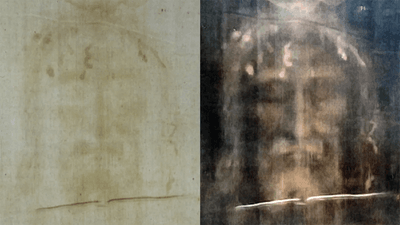


A new study has analyzed DNA found on the Shroud of Turin, a large piece of linen cloth used to wrap the body of Jesus Christ, according to believers, and a clever medieval hoax, according to radiocarbon dating.
The rest of this article is behind a paywall. Please sign in or subscribe to access the full content.The Shroud of Turin, as far as historical records show, first showed up around 1353–1357 CE (the "CE" here being quite unnecessary, given that it is supposed to depict Jesus of Nazareth), in the possession of French knight Geoffroi de Charny. No record remains of how de Charny got his own hands on the object.
Given how the shroud has been seen as authentic by many modern Christians and several popes throughout the years, you might think that people of the time did not question the veracity of the object back then, but that is not the case. When the shroud went on tour in 1389, the bishop of Troyes called it "cunningly painted, the truth being attested by the artist who painted it."
Nevertheless, popes through the years have made pilgrimages to the shroud, with Pope Francis visiting it as late as 2015.
“The icon of this love is the shroud, that, even now, has attracted so many people here to Turin,” Francis said of the shroud, per The Guardian. "The shroud draws [people] to the tormented face and body of Jesus and, at the same time, directs [people] toward the face of every suffering and unjustly persecuted person."
The shroud, or relic, depending on your view of the object, is rarely on display today. However, it has been submitted to scientific testing in recent years, in order to try and pin down when and where it was created. On that front, it doesn't look too good for believers. Carbon dating of samples taken from the shroud by several laboratories has concluded that the cloth was made between 1260 and 1390 CE, suggesting that it was forged around the time that it entered the historical record.
In a new study, which has not yet been peer reviewed, researchers analyzed samples obtained in 1978 and subjected them to a thorough DNA analysis. Looking at the results, the team found a diverse array of plant and animal species on the shroud.
As expected, they found DNA from several people who had handled the shroud in the meantime. One of the more interesting finds was the plant and vegetable matter found on the samples, including wild carrot, oranges, bananas, and peanuts.
"We demonstrated that the carrot DNA found on the Shroud is genetically more similar to early cultivars and improved cultivars, which were proven to descend from orange carrot varieties developed in Europe between the 15th and 16th centuries," the team writes, adding that oranges and bananas were introduced to the continent during the high-late Middle Ages.
Though later contamination cannot be ruled out, other species found on the shroud were from this later period too. But it is the absence of other plants that is more puzzling, if you believe the shroud to be a genuine relic from the time of Jesus.
"The prevalence of Mediterranean crops and the absence of typical Middle Eastern flora raise questions about the agricultural landscape when the Shroud was created or used as a burial cloth," the team adds. "Comparative analyses with other ancient textiles and artifacts could further illuminate cultural and historical interactions with plants and animals."
In terms of animals, the team found a wide range, including pigs, sheep, goats, chickens, rabbits, and horses, as well as domestic cats and dogs. From this, the team suggests that the shroud has Mediterranean origins or was contaminated during transit through this region.
The team also found a few surprises when looking at the human DNA.
"A quantitative assessment of the overall amplicon sequencing data revealed that over 55.6% of the human DNA corresponds to lineages from the Near East, while Western European lineages account for less than 5.6%," the team writes. "The presence of 38.7% of the overall human genomic data from Indian lineages is unexpected and is potentially linked to historical interactions associated with importing linen or yarn from regions near the Indus Valley, referred to as 'Hindoyin' according to rabbinic texts."
Again, given what we know of trade in the past, this makes an authentic relic scenario more unlikely. Nevertheless, it appears to be an interesting fake, with plenty of secrets to reveal through DNA analysis, shedding light on the history of plants and animals in the region through DNA left on it over the centuries.
The study is posted to the preprint server bioRxiv.