Humans
 PUBLISHED


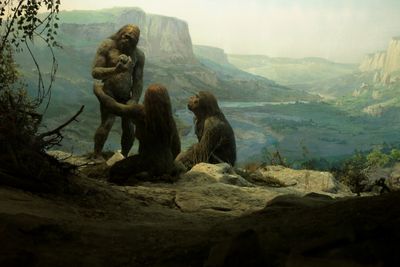


The disappearance of the Neanderthals has long puzzled researchers, with theories ranging from competition with Homo sapiens to outright violence. A scientific paper in 2022, however, suggests a far less dramatic cause. Rather than being wiped out in battle, Neanderthals may have simply merged themselves out of existence through repeated interbreeding with Homo sapiens.
The rest of this article is behind a paywall. Please sign in or subscribe to access the full content.Since scientists have sequenced the genomes of Homo sapiens and Neanderthals, we've known that around 2 percent of the genome of humans living outside of Africa comes from Neanderthals. Meanwhile, about 0.3 percent of Africans’ genomes come from Neanderthals due to interbreeding taking place after Homo sapiens left the continent between 60,000 and 90,000 years ago. However, when we look at Neanderthal DNA, we do not find Homo sapien DNA.
In the study paper, researchers from the Natural History Museum assess possible reasons for the one-way exchange of DNA and discuss how it was that these two groups interacted with each other and made these "genetic exchanges". They suggest that the absorption of Neanderthal individuals into the Homo sapien population could have helped lead to the Neanderthal demise.
"Our knowledge of the interaction between Homo sapiens and Neanderthals has got more complex in the last few years, but it's still rare to see scientific discussion of how the interbreeding between the groups actually happened," the Natural History Museum's research lead Professor Chris Stringer said in a press release back in 2022.
"We propose that this behaviour could have led to the Neanderthals' extinction if they were regularly breeding with Homo sapiens, which could have eroded their population until they disappeared."
The team note that when humans and Neanderthals met again in Europe 60-90,0000 years ago, it had been hundreds of thousands of years since their divergence.
"Without knowing exactly what Neanderthals looked or behaved like, we can only speculate what Homo sapiens would have thought of their relatives,' Stringer said. "The language differences would probably have been greater than we could imagine, given the time depth of the separation, and would have been much larger than those between any modern languages."
Nevertheless, we know that – despite these hurdles – genetic information was exchanged. The team point to mating between different chimpanzee groups, as well as between groups of hunter-gatherers, as possible models for what took place between Homo sapiens and Neanderthals. In chimpanzees, groups have been observed seizing females from rival groups, but males and females have also been observed covertly soliciting and coupling with rival group members away from their respective groups.
"More structured movements of partners among recent hunter-gatherers vary according to local demographic conditions," they write in the study, "and thus may also have developed between Neanderthal and H. sapiens groups at times".
What intrigued the team is the apparent one-way exchange of genetic information. In the 32 genomes of Neanderthals that have been sequenced so far, we haven't found evidence of Homo sapien DNA. This could be because breeding between the two groups was only possible in one direction (like in Ligers, where a male lion mates with a female tiger). The lack of Neanderthal mitochondrial DNA (which is inherited via females) in living humans suggests that only male Neanderthals and female Homo sapiens could produce offspring successfully. It may also be the case that male hybrids were less fertile.
One possibility is that Neanderthal groups were not absorbing Homo sapiens into their groups, but Neanderthals were being absorbed into Homo sapien populations. The team argue that if further evidence suggests Neanderthals were absorbed into human populations but not the other way around, it could provide an explanation for the decline of the Neanderthals.
"If fertile Neanderthals were regularly being absorbed into H. sapiens groups (by whatever mechanisms) during that time period, they were effectively also being removed from Neanderthal gene pools, and such a consistent drain of prime-age individuals is not something that could have been sustained for long in small hunter-gatherer groups," they write in the paper.
"Perhaps dispersing H. sapiens groups acted like sponges in absorbing pockets of late Neanderthals and maybe that, as much as anything else, led to the eventual demise of the Neanderthals as a viable population."
The team adds that more evidence is needed, and more Neanderthal genomes need to be sequenced, to see whether this is the case. This may come from DNA already found in cave sediments. At the moment, we have to wait and see what that evidence turns up, to know whether Neanderthals met their ends through mating and integrating with humans, to the point that they couldn't sustain their own dwindling populations.
"We don't know if the apparent one-way gene flow is because it simply wasn't happening, that the breeding was taking place but was unsuccessful, or if the Neanderthal genomes we have are unrepresentative," Stringer said.
"As more Neanderthal genomes are sequenced, we should be able to see whether any nuclear DNA from Homo sapiens was passed on to Neanderthals and demonstrate whether or not this idea is accurate."
The paper was published in PaleoAnthropology.
An earlier version of this article was published in 2022.