Nature
 PUBLISHED



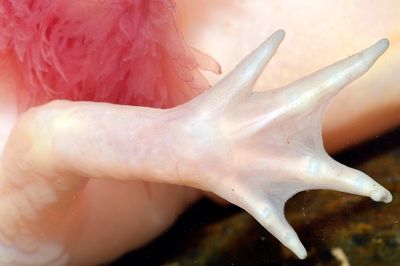


It has been a persistent mystery. Why is it that some amphibians, such as salamanders and frog tadpoles, can regenerate lost limbs while mammals can’t? For decades, scientists have tried to understand why this is the case, but this amputation problem has stumped them.
The rest of this article is behind a paywall. Please sign in or subscribe to access the full content.Now, research led by scientists at the Swiss Federal Technology Institute of Lausanne (EPFL) offers a new perspective on the problem by focusing on an unlikely factor: oxygen. Although it is still early days, the results may eventually unlock new ways to improve wound healing in humans.
Limb regeneration has its roots in wound healing. Once a limb has been amputated, cells at the injury site start to seal up the wound and switch to regenerative cell types. If the process runs smoothly, in the right organism it can result in a newly re-grown limb. This is what happens in amphibians. However, if the process stalls – as it does with humans and other mammals – the wound closes much slower, allowing scars to form that eventually block regeneration.
Over the years, there have been various competing explanations for why mammals can’t regenerate beyond this point. Some have suggested the reason is a failure to form regenerative cells. For example, when an amphibian is injured, it can “de-differentiate” its cells, turning muscle or bone cells into stem cells. These can then gather at the wound to form a blastema – a cluster of undifferentiated cells – that serves as a progenitor of regeneration.
This process doesn’t occur in humans; instead, our bodies prioritize closing up the wound with scar tissue – fibrosis – to stop bleeding and to prevent infections.
Another explanation for why amphibians can regenerate and mammals cant relates to the evolution of thermoregulation. This argument posits that mammal’s ability to maintain a constant, warm body temperature may have cost us the ability to regrow lost limbs.
But can the environment play a role here? For one thing, many regeneration-competent species live in aquatic environments. For instance, amphibian larvae start their lives in water, where oxygen levels are much lower than in the air. In contrast, wounded mammalian tissue is exposed to the much higher oxygen levels of the world above the surface.
This situation has been recognized for a long time, but it has been unclear whether it was just a consequence of lifestyles or played a direct role in limb regeneration. The new research shows that oxygen does indeed play a crucial role in limb regeneration. In a study that compared amputated limbs from frog tadpoles and embryonic mice, the team discovered that the way cells detect oxygen influences whether regeneration can begin.
“For a long time, regeneration research focused on amphibians, while mammalian regeneration was rarely examined experimentally side by side in a comparable manner,” Can Aztekin at EPFL explained in a statement.
“Although many studies showed that regenerative species such as amphibians and mammals share similar genes, suggesting that mammals may retain a latent regenerative capacity, it remained unclear whether mammalian tissues can indeed activate limb regenerative programs, and what prevents them from doing so.”
In this study, Aztekin and colleagues amputated developing limbs from frog tadpoles and mouse embryos. These limbs were then cultured outside the body under controlled oxygen conditions. In some cases, oxygen levels were lowered to match those found in aquatic environments, while others were raised close to the levels found in air. The team then tracked how the cells responded by measuring wound closure, cell movement, gene activity, metabolism and epigenetic states – such as changes to DNA packaging.
This analysis focused on HIF1A, a protein that regulates cellular responses to low oxygen. When oxygen is low, the protein becomes stable and activates programs that initiate healing and regeneration processes around a wound.
The team found that lowering oxygen levels had a distinct impact on the limbs of mouse embryos. Under this condition, their cells closed wounds faster and seemed to enter a regenerative program. When the team stabilized HIF1A, they saw the same effects, even when oxygen levels were high.
Low oxygen levels had other effects too. In addition to speeding up wound closure, the researchers found that cell behavior changed too. Skin cells became more mobile and were able to alter their mechanical properties. At the same time, metabolism shifted toward glycolysis, an anaerobic process that takes place during low-oxygen conditions.
The team also found that chemical marks on DNA-associated proteins changed to favor the activation of regeneration-related genes.
The situation was different for frog tadpoles. Their limbs regenerated efficiently across a large range of oxygen levels, even in conditions that were above those found in air. It seems their cells maintain stable HIF1A activity even when oxygen is high. This is due to a low expression of genes that normally shut down this pathway.
Throughout this research, the biologists found that regeneration-competent amphibians demonstrated reduced oxygen-sensing capacity, allowing their regenerative program to begin and to be sustained. Mammals, on the other hand, showed the opposite. The cells of mice and humans tested in this work responded strongly to oxygen and switched regenerative programs off quickly after injury.
This suggests that mammalian limbs retain latent regenerative potential at early stages of development, depending on how their cells respond to environmental signals, e.g. oxygen levels. This means that changes to oxygen-sensing pathways could one day enhance wound healing or regenerative responses in humans.
Crucially, the findings highlight the activation of regenerative mechanisms in mammals only, not the complete regrowth of full limbs. It would be a mistake to think this study suggests that human limbs can be regrown imminently. Instead, it demonstrates that differences that were once believed to be fixed between species – like the ability to regenerate – may actually be affected by how cells respond to the environment.
“By directly comparing species that can and cannot regenerate, we bring a fresh perspective to a centuries-old question. Our results show that regenerative programs can be triggered in mammalian tissues and begin to outline a clear, testable path toward promoting limb regeneration in adult mammals,” Aztekin added.
The paper is published in Science.