Nature
 PUBLISHED
 1
1


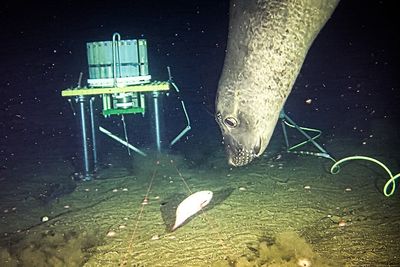


While studying some humdrum sealife activity off the coast of Canada, scientists stumbled across a band of northern elephant seals exhibiting a fascinating behavior: each time the device let out a pulse of sonar, the seals headed down for a meal, just like the ringing of a dinner bell.
The rest of this article is behind a paywall. Please sign in or subscribe to access the full content.The behavior was observed while studying how deep-sea fish and invertebrates reacted to different stimuli in the waters of Barkley Canyon, off the coast of southern Vancouver Island.
The researchers eventually noticed that eight northern elephant seals would make regular trips to their device, submerged at a depth of 645 meters (2,116 feet), whenever it made a noise generated by the sonar.
“We suspect the seals have learned to associate sonar noise from the research instrument with the presence of food—a phenomenon known as the ‘dinner bell’ effect,” Héloïse Frouin-Mouy, lead study author from the University of Miami and the University of Victoria, said in a statement.
“The seals appeared to use this sound to locate an area with prey and may take advantage of fish disturbed by the camera lights, particularly targeting sablefish, their preferred meal as seen in the video footage."

The eight seals, by the way, were named after members of The Beach Boys: Brian, Dennis, Carl, Mike, Al, David, Blondie, and Bruce. After all, they did hone their hunting skills by picking up "good vibrations” from the sonar equipment.
“We became familiar with the mammals and ended up naming them in the paper after members of The Beach Boys to differentiate between the frequency of visits and observed habits,” Frouin-Mouy explained.
Along with documenting the “dinner bell” effect, the researchers also spotted some never-before-seen resting behavior among the adolescent elephant seals. The team’s footage showed that some of the "Beach Boys” would often take “power naps” on the seafloor at Barkley Canyon, laying motionless for minutes at a time. The longest nap was up to 8 minutes 40 seconds, after which the individual was forced to return to the surface for air.
Barkley Canyon is a strip of seafloor home to geological features that seep thermogenic gas, attracting an array of lifeforms. In a previous experiment at the site, scientists placed the giant rib bones of humpback whales at a depth of 890 meters (2,919 feet) inside the underwater canyon. Using a specialized camera system, the team watched as the sunken feast lured in a wealth of scavengers, from tiny crustaceans to king crabs.
Let’s hope those sneaky seals don’t catch wind of this experiment too…
The study was published in the journal PLOS ONE.