Health and Medicine
 PUBLISHED




How does consciousness work? It remains a profound and puzzling question, especially when you consider the many ways consciousness can play out. For instance, aside from the everyday mental states we experience in our lives, there are various rarer, non-ordinary states of consciousness – such as those reached through meditation, hypnosis, sleep deprivation, extreme stress, or the use of substances like psilocybin – that can tell us a lot about how our minds work.
The rest of this article is behind a paywall. Please sign in or subscribe to access the full content.However, these altered states of mind have been historically tricky to research. But in a new neuroimaging study, researchers examine the brain activity of a woman who can voluntarily enter a transcendental visionary state. They found that, when the participant entered this non-ordinary state, her brain connectivity reorganized itself – her visual and somatosensory connections decreased and her frontoparietal network increased.
Non-ordinary states of consciousness, especially those that are reached through anesthetics or psychedelics, have become increasingly valuable for neuroscience. These altered states of mind often involve changes to a person’s perception, especially of time, and can also include intense imagery and a greater sense of connection with their environment. And while some altered states of consciousness can be seen as pathological, some are actually deliberately induced for spiritual or religious purposes.
One example of this is the transcendental visionary state, which involves vivid internal imagery that is often deeply symbolic or archetypal, and a profound sense of unity and transcendental awareness. Someone who experiences this altered state may report a significant reduction in their personal boundaries as they feel more connected with a larger reality. Importantly, transcendental visionary states can be produced without the help of psychedelics or other substances.
This means people who can achieve this state of mind are useful for neurological research. Although psychedelics and anesthesia can artificially produce altered states of consciousness, they alter the brain’s chemistry, limiting our ability to measure the mechanics behind the participant’s experience. At the same time, these pharmacologically induced states are less predictable.
In this latest study, researchers in Argentina examined a case study of an individual who can intentionally enter into a transcendental visionary state on demand. She was able to reproduce this state of mind without drugs and consistently across multiple sessions where she was scanned using functional magnetic resonance imaging (fMRI). While in this state, the 37-year-old woman reported the typical sensations and characteristics of transcendental experiences, including shifts in time perception, loss of ego, and visual imagery.
“The participant did not receive formal training in techniques for inducing non-ordinary states of consciousness. Her practice developed intuitively and independently from early adolescence, as part of a sustained curiosity about the nature of perception and consciousness,” the authors write in their paper.
“At age 24 she experienced a spontaneous visual phenomenon (a yellow shape projected onto a blank surface) that she later learned to reproduce voluntarily through self-guided experimentation. Over time, she progressively refined this ability through reasoning and introspection, rather than through any specific contemplative or meditative method.”
The practice has since become “a continuous mode of perception and inquiry” for the woman – named as “AVP” and listed as an author on the study – rather than a daily exercise.
For this study, AVP was interviewed multiple times using micro-phenomenological interview methods – a structured, qualitative research method designed to identify first-person descriptions of specific lived experiences. She also completed 20 fMRI sessions across a five-month period. The researchers also scanned the brains of a control group made up of 10 other women who matched AVP in age and level of education. These women were simply asked to close their eyes and imagine vivid scenes while they were being scanned.
When AVP entered the scanner for each session, she initially scanned her own body, loosened her muscles, and allowed herself to feel progressively lighter. Here, the sound of the MRI scanner actually helped her stabilize her experience, serving as a kind of “mantra”.
After this, during the Transition phase, she reported in the micro-phenomenological interviews that she found she had to put more effort into sustaining the process.
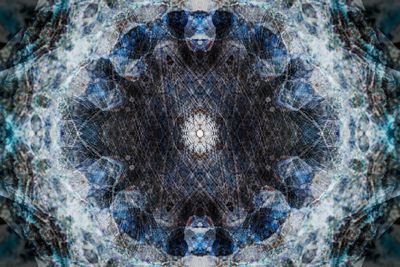
It started with the emergence of violet coloration replacing the dark visual field. This was followed by the gradual appearance of a yellow-violet hexagonal lattice seen as a kind of “structured pattern” in the air surrounding her. AVP also reported a distinct double consciousness – she was fully aware of the scanner but also felt connected to a broader field of experience suffused with “serenity, unity, and a reduced fragmentation of time”.
In her body, she sometimes reported feeling tension and instability, and sometimes she experienced marked lightness and a diffuse sense of expansion.
After this middle phase, AVP’s experience stabilized into vivid visionary experiences accompanied by profound calmness, a blurring of her bodily boundary, and spatial expansion.
“She reported an 'eternal present,' a continuous temporal flow with minimal segmentation. Across sessions, the most stable phenomenological motif was the hexagonal network coupled with rhythmic violet pulses. As the state deepened, lucid dream-like scenes emerged: landscapes, horizons, and interactions with imagined figures felt vividly present”, the team explained.
In one session she was able to imagine uncrossing her legs, which resulted in real bodily sensations despite her being completely immobile.
These experiences were remarkably consistent across the 20 sessions. During this time, the neuroimaging data matched her reported experience. During the Transition phase, her brain connectivity became much more variable, suggesting a destabilization of her typical network organization. Once her state stabilized, her overall visual cortex showed dramatic reduced connectivity her auditory, sensorimotor, orbitofrontal, thalamic, and cerebellar regions.
Her somatomotor-dorsal network – a large-scale brain network that connects external sensory input with internal motor output – disengaged from her auditory and language cortices which, as the authors wrote, paralleled “the reported visual phenomena and changes in bodily experience.”
At the same time, her frontoparietal and salience networks demonstrated increased coupling with the precuneus and posterior cingulate, multimodal temporal cortex, and cerebellar hubs. This occurred in agreement with AVP’s reports of sustained inward-directed attention. Her overall brain activity, at this point, shifted towards lower entropy – which means there was less random noise – and higher statistical complexity, before she returned to her baseline state.
None of these changes were seen in any of the control subjects.
“This study demonstrates how a self-induced [non-ordinary conscious states] can be characterized as a coherent yet reorganized mode of conscious experience, with reproducible large-scale signatures tightly aligned with a phenomenological sequence,” the team conclude.
“It highlights the value of integrating first-person reports with network-based neuroimaging and suggests that volitional modulation of consciousness may reveal general principles of brain dynamics across diminished and expanded states of awareness.”
But while this study goes a long way to demonstrate how the brain can reorganize itself when someone enters into a different state of consciousness, it is limited to a single in-depth example. Further research will need to a wider range of participants to assess whether AVP’s changes are typical for someone entering this state of mind or unique to her.
The study is published in the journal NeuroImage.


 1
1