Nature
 PUBLISHED


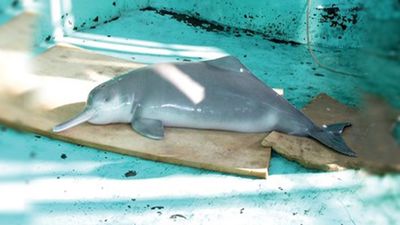


In 2002, QiQi, the last known dolphin of its kind, died after spending its final years alone in a tank at the Institute of Hydrobiology in Wuhan. Later efforts to find others of the species in the wild have come up empty, but its apparent demise is providing the next generation of conservationists with hard-won lessons for the new challenges still ahead.
The rest of this article is behind a paywall. Please sign in or subscribe to access the full content.QiQi was a baiji (Lipotes vexillifer), a river dolphin native to the Yangtze river system in China. Not to be confused with other Yangtze river residents, such as the Chinese white dolphin or the finless porpoise, it is the sole known member of the genus Lipotes.
Known as the "Goddess of the Yangtze", this elusive cetacean looked like a shrunken-down dolphin with a peculiarly long snoot and an unusually shallow dorsal fin. Its eyes were tiny and largely vestigial as it had become almost entirely reliant on echolocation after millennia of living in murky, muddy waters.
Thousands of baiji are thought to have once swum through China's longest river, but the species came under enormous pressure when the country was aggressively thrust into rapid modernization in the latter half of the 20th century. As industrial and domestic waste flooded into the river, pollution placed mounting stress on the population. Ship traffic multiplied, posing further danger. To make matters worse, widespread food shortages drove many people to the river to hunt the dolphins for their meat and blubber.
Conservation records are unsurprisingly scant from the era of Chairman Mao, but some estimates suggest there were thousands of baiji in the Yangtze in the 1950s. These numbers dwindled to around 400 by the early 1980s and, by the late 1990s, only a handful of individuals remained in the wild. China attempted to solve the problem by installing protections in certain parts of the Yangtze, but the river system was plagued with much wider problems.
“Sections of the main river were designated as cetacean reserves. It’s a hands-off approach – if you can mitigate the threats in the species’ natural environment, you then don't need to do something more intensive,” Professor Sam Turvey, a conservation expert from the Zoological Society of London, told the Natural History Museum in 2022.
“However, it wasn’t really possible to create protected areas that would remove all of those threats. If pollution is being released into the river, then it can flow downstream through protected areas, and ship traffic still needs to get upstream to reach inland ports,” he explained.
There were also discussions about launching breeding programs, but with so few individuals left in the wild, researchers simply didn't have enough animals to make it work.
The sole glimmer of hope was a small number of baiji that had been captured in the early '80s and placed into captivity at a few different laboratories, including the Wuhan-based Institute of Hydrobiology, Nanjing Normal University, and the Nanjing Fisheries Research Institute.
One of those was QiQi at the Institute of Hydrobiology. Most of the captured baiji died within the decade, but this lone individual managed to survive for over 22 years, only passing away on July 14, 2002.
The death prompted scientists to mount a last-ditch attempt to find a baiji in the wild. But after a six-week expedition on the Yangtze in 2006, scientists found no living individuals and declared the species functionally extinct.
"The baiji is functionally extinct. We might have missed one or two animals, but it won't survive in the wild," August Pfluger, a Swiss naturalist involved in the expedition, told the Guardian in 2006. "We are all incredibly sad."
There have since been odd sightings of baiji in the Yangtze, such as one in 2007 and another in 2014, but these were not officially confirmed. It is very likely that these were cases of mistaken identity, with hopeful observers confusing the species with a faintly related doppelgänger species, the Yangtze finless porpoise.
The sad story of the baiji has been dubbed the “first human-caused extinction of a cetacean species,” and it is one China is keen to avoid repeating. Conservation efforts once directed at the baiji have since been redirected towards the Yangtze finless porpoise, the river's sole remaining cetacean. With the hard lessons of this loss in mind, it is hoped that the finless porpoise can be spared a similar fate.