Humans
 PUBLISHED


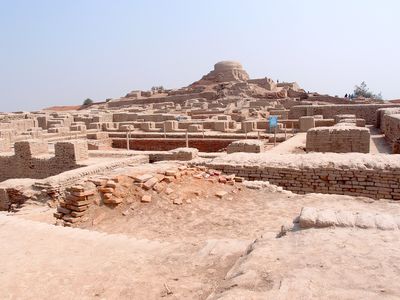


Mohenjo-daro, one of the greatest urban centres of the ancient world, appears to be even older than thought. New radiocarbon dating at the site's city walls suggests it was occupied as early as 2700-2600 BCE, centuries earlier than previous estimates.
The rest of this article is behind a paywall. Please sign in or subscribe to access the full content.The ruins of Mohenjo-daro, meaning “Mound of the Dead Men,” are found along the banks of the Indus River, whose fertile floodplains gave rise to some of the world's first urban civilizations and great Bronze Age societies. Today, the site lies within Sindh, a province in southwestern Pakistan, and is widely considered the largest and best-preserved of the lot.
At its peak, at least 40,000 people called the city home, living among burnt-brick structures spread across 240 hectares (593 acres), only about a third of which has been excavated since work began in 1922.
However, it isn’t just its size that makes Mohenjo-daro significant. The city was remarkably sophisticated, with evidence of advanced art, religion, and civic administration. Perhaps most striking was its water infrastructure, complete with elaborate baths, wells, and specialized sewage pits, that rivaled anything else in the ancient world. This was much more than a village that had simply grown beyond control – it was a highly organized urban center that demanded a complex culture and a degree of centralized authority to build and sustain.
Until recently, scholars generally held that Mohenjo-daro emerged around 2500 BCE, although parts of the city's early history had previously been murky. Now, a recent geoarchaeological survey by the Sindh Directorate General of Antiquities & Archaeology (DGAA) has helped to fill in its first known chapter.
The work provides new radiocarbon dates for a massive mudbrick wall that surrounds the western Stupa Mound, an elaborate structure in the "citadel" part of the “upper” city. This revealed that the city wall was constructed a couple of centuries before the widely accepted date. The ancient metropolis, it turns out, was already taking shape before the Egyptians started to build the Great Pyramids of Giza around 2600 BCE.
“Pottery and carbon samples from the lowest levels of the first wall indicate that this initial structure was constructed at the end of the Early Harappan or Kot Diji Phase, around 2700-2600 BCE, approximately 100 years before the beginning of the Harappan Phase,” the DGAA said in a statement, according to Arab News.
The excavations also shed light on some later stages of the city's evolution. “The walls were expanded and maintained until around 2200 BCE and possibly even longer. Future investigations will trace the plan of the city wall around the Stupa Mound in order to try and locate gateways and to determine how this wall functioned and when it began to erode,” the DGAA statement continues.
While the origins of this ancient metropolis are coming into sharper focus, its demise remains as mysterious as ever. Mohenjo-daro flourished until it was left to ruin sometime between 1800 and 1700 BCE, but the cause of its abandonment is unknown. Some researchers have suggested it fell victim to a sudden catastrophe – perhaps a flood or a great fire, maybe an invasion or plague – although hard evidence of such a cataclysm is scarce. There are no signs of fire or flooding, nor any traces of a battle. Dozens of skeletons have been found at the site, but the circumstances of their deaths point to no single, defining disaster.
What we do know is that Mohenjo-daro was not alone in its ill fate. Around 1800 BCE, many of the great civilizations of the broader Indus Valley fell into steep decline. One leading theory holds that the region was struck by a prolonged megadrought, gradually strangling the agriculture on which these cities depended. But as with so much else about the ancient world, the full story remains unknown.