Nature
 PUBLISHED


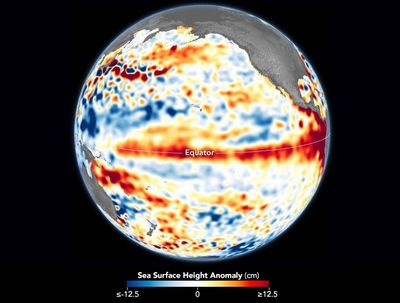


It’s looking increasingly likely that an El Niño event will arise later this year. If those predictions are on the money, we could be in for a wild 2026 and 2027, climate-wise.
The rest of this article is behind a paywall. Please sign in or subscribe to access the full content.Released on April 9, the latest forecast from NOAA’s Climate Prediction Center states a 61 percent chance that El Niño will emerge in May-July 2026 and persist until at least the end of the year. It adds that there's an 80 percent chance that El Niño-Southern Oscillation (ENSO)-neutral conditions will be "favored" through April-June 2026.
The EU’s Copernicus Climate Change Service is dropping similar, slightly subtler hints. It notes that March 2026 had its second-warmest global sea surface temperature on record, which it describes as "reflecting a likely transition toward El Niño conditions."
Many climate centers said they suspected El Niño is rearing its head earlier in 2026, but as we creep through the year, their predictions are starting to come into sharper focus. Some even suggested that a super-strong El Niño could be on the cards. While it’s still too soon to declare that, researchers have good reason to be wary.
The most recent El Niño event unfolded during the 2023-2024 season, but these warming events typically happen every two to seven years. Should another occur in 2026, it would be pretty unprecedented.
If you're not a meteorologist or hardcore weather fan, this might sound like a bunch of abstract concepts and buzzwords, but there’s a good reason why you should pay close attention. Here’s everything you need to know.
What is El Niño?
The ENSO is a naturally occurring climate cycle driven by fluctuations in ocean temperatures and atmospheric pressure across the eastern tropical Pacific Ocean. These conditions here have a knock-on effect that's felt across the globe, influencing everything from rainfall to droughts, tropical cyclones, heatwaves, and more.
The ENSO shifts between three phases: El Niño (the warm phase), La Niña (its cooler counterpart), and a neutral state.
The world has only just left a La Niña state and entered ENSO-neutral conditions, marked by a return to near-average sea surface temperatures in the eastern equatorial Pacific. As such, it looks like the planet could be swinging back towards warmer Pacific temperatures and El Niño conditions.
What effect will El Niño have on the world?
In a punchline, El Niño can raise global temperatures by up to ~0.2°C, fueling extreme weather like droughts and floods. In a world already warmed by greenhouse gas emissions, an El Niño event can add an extra temperature boost, increasing the chances of record-breaking warmth.
Even with La Niña's cooling influence, 2025 still ranked among one of the warmest years on record. Strip that away, add the warming push of an incoming El Niño, and 2026 and 2027 could be warmer still. The past 11 years have already been the 11 hottest on record. If El Niño does materialize, the streak shows no sign of stopping.
Beyond global average temperatures, El Niño will bring widespread weather changes. Expect to see increased rainfall and potential flooding in the southern US and southern Europe, while northern US and Canada are drier and warmer than usual. Over in the Atlantic Ocean, El Niño actually weakens hurricane seasons, but strengthens hurricane activity in the central and eastern Pacific basins.
Who knows for certain what the rest of 2026 will hold, but the threat of a strong El Niño is looming large.