Space and Physics
 PUBLISHED


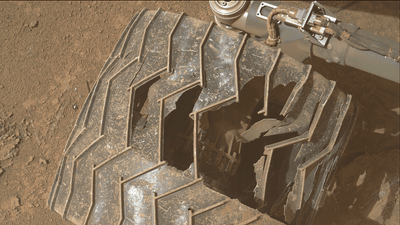


New raw images returned to Earth from Curiosity on Mars show that NASA's rover may be in a spot of trouble, with extensive damage appearing on one of its wheels.
The rest of this article is behind a paywall. Please sign in or subscribe to access the full content.Curiosity has been roaming the Red Planet for nearly 14 years now, having landed at Bradbury Landing in the Gale Crater in August 2012. The rover has fared well over this time, far surpassing its initial two-year mission, and traveling a distance of 36.6 kilometers (22.7 miles) at the time of writing.
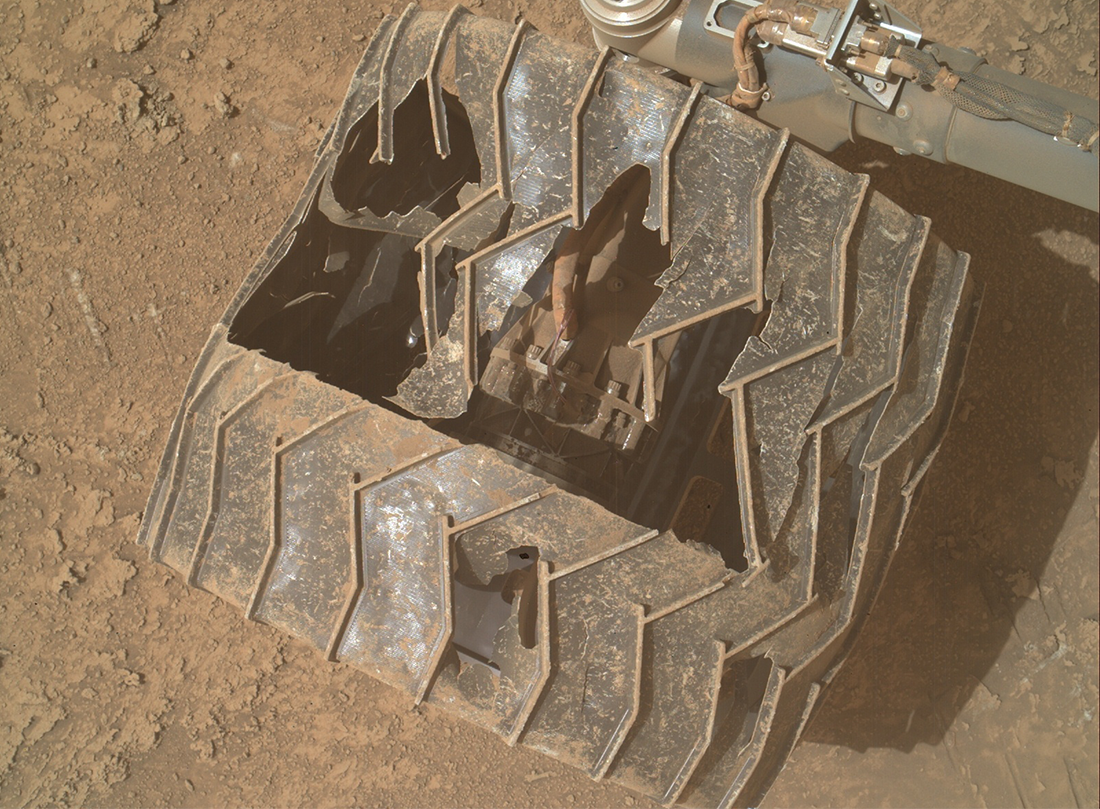
But that travel has taken a toll on the rover's wheels, with signs of wear and tear first beginning to appear back in 2013. It's now over 13 years later, and they aren't looking any prettier. The rover images its thin aluminum wheels at regular intervals to keep an eye on the damage in case any action needs to be taken about it. In new raw photos sent back from the rover, the treads (or grousers) on the middle-right wheel clearly have new damage for the Curiosity team to worry about.
So, what can NASA do from another planet? There aren't exactly a lot of tire replacement shops on Mars. But NASA does have several plans in place to deal with the issue, and it may involve finding a sharp rock and performing a little self-surgery.
The first part of the plan has already been carried out; redirecting the rover away from terrain that causes it the most damage, slowing further deterioration.
"A large percentage of early mission driving was done on caprock on the plains. The transition onto the softer bedrock of Mount Sharp (Murray Formation) marked a key inflection point in the damage curves of the front and middle wheels," a NASA paper looking into the damage explains. "Most wheel wear accumulated since leaving the Pahrump Hills region at 11,000 [kilometers, 6,835 miles] is associated wheel interactions with small pebbles and occasional unavoidable rocks that are largely terrain type independent."
Another step, taken in 2017, was giving the rover a software update and a new algorithm to mitigate further damage.
"The traction control algorithm uses real-time data to adjust each wheel's speed, reducing pressure from the rocks," NASA explained. "The software measures changes to the suspension system to figure out the contact points of each wheel. Then, it calculates the correct speed to avoid slippage, improving the rover's traction."
When the rover first started showing signs of damage, NASA used a double of Curiosity – named Scarecrow – here on Earth to test how well it could continue should one of the wheels fail. But if the damage is extensive enough, it would require the rover to get rid of it to keep trundling on.
"Although Curiosity’s wheels continue to accumulate damage as the rover continues to drive across mixed Martian terrain, an individual wheel can absorb significant damage before it causes any impact to mobility performance," the NASA paper explains. "Testing in the JPL Mars Yard on the Scarecrow testbed rover indicates that Curiosity could continue to drive indefinitely on the portion of a wheel that remains when all the grousers on a wheel breaks, if the unconstrained portion of the wheel can be safely shed."
While lopping off a wheel may seem drastic, NASA worries that cables within the rover could become damaged should the rover simply continue on, dragging its damaged wheel rather than shedding. So, how would NASA achieve this? It's not like they provided the rover with a saw "just in case". Instead, the rover will have to make use of the tools it finds around itself, which on Mars is all rocks, in order to break off the grouser section of the wheel, leaving a rimmed wheel.
This part, NASA practiced with Scarecrow, making the replica rover snap off its wheels through a few methods. Though NASA has a couple of maneuvers – the "Twist and Shout Maneuver" and the "Pigeon Toe Maneuver" the basic idea is the same: get the damaged wheel trapped, and then drive with the remaining wheels until it snaps off.
Though the damage does look significantly worse than it has in the past, it is not yet clear whether NASA will attempt this drastic step. For now, the rover continues on despite the damage, far outlasting its initial two-year mission.


 1
1