Space and Physics
 PUBLISHED


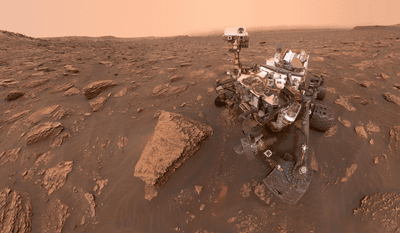


Organic molecules found by the Curiosity rover are too common to be explained by any process we know, other than life, according to a new study. That, of course, doesn’t rule out the possibility that some unknown process was responsible, but it marks the second sample where ancient life is now the most obvious answer to the measured composition.
The rest of this article is behind a paywall. Please sign in or subscribe to access the full content.In March 2025, a paper announced the discovery of the largest organic molecules yet found on Mars in Cumberland mudstone that Curiosity collected at a site called Yellowknife Bay. These molecules, known as long-chain alkanes, are known to be the products of life, but are also produced by certain chemical reactions that don’t require biology.
At the time, the most exciting part of the discovery was that the molecules were 3.7 billion years old, dating from the time when Mars was wet and was most likely to have hosted life. That indicated that if the Red Planet supported organisms during its blue phase, the evidence should still be there for us to find.
That work was overshadowed six months later with the announcement that Perseverance had found a rock at Cheyava Falls whose contents chemists couldn’t find an explanation for other than ancient living organisms. The Cheyava sample was quickly referred to as the “clearest sign of life that we've ever found on Mars”, but perhaps the Yellowknife sample also deserves a place on that podium. That’s because, even though there are non-biological ways to make molecules like those in the mudstone, they probably wouldn’t leave this many.
Dr Alexander Pavlov of NASA’s Goddard Space Flight Center and co-authors started by estimating how many long-chain alkanes the sample once had. Previous research on Gale Crater reveals the mudstone was buried for 3.6 billion years, and reached the surface 78 million years ago. Cosmic radiation that it would have encountered at the surface slowly destroys alkanes like these, so the team considered the loss rate to calculate the abundance when that exposure began.
With long-chain alkanes currently representing 30-50 parts per billion in the sample, Pavlov and co-authors conclude they must have been more than 2,000 times as common before the radiation exposure. They estimate the abundance when Earth was in the late Cretaceous would have been around 120-7,700 parts per million (ppm), either of long-chain alkanes, or of fatty acids that convert to them. The wide range reflects uncertainties about whether common Martian chemicals accelerate the effects of radiation on the alkanes, but even the lower estimate carries big implications.
“Such a high concentration of large organic molecules in Martian sedimentary rocks cannot be readily explained by the accretion of organics from carbon-rich interplanetary dust particles and meteorites, nor by the deposition of hypothetical haze-derived organics from an ancient Martian atmosphere,” the authors write.
In an effort to leave no mudstone unturned, the authors also consider the possibility that the alkanes were made by hydrothermal vents when Mars was both wetter and more volcanic. The authors say they lack the capacity to calculate how many long-chain alkanes such a process would produce. Nevertheless, an abundance of 120 ppm from this source is inconsistent with the proportion of carbonates in the surrounding environment.
On the other hand, alkanes are found in this abundance on Earth, having been produced by organisms, so the same could be true on Mars; the authors stress they are not claiming this is what happened.
These estimates still need to be considered by the wider astrobiology community. However, the dating component relies on work done using three independent isotopes 12 years ago and is unlikely to be challenged.
If the rest of Pavlov and co-authors' work holds up, however, the possibility of processes we have not observed or imagined still can’t be ruled out. Nevertheless, the more things we find that could easily be the products of living things, and are hard to explain any other way, the stronger the case for ancient Mars life becomes.
When the Curiosity and Perseverance rovers were being designed, they probably lacked the capabilities to find conclusive proof of life. That’s why the Mars Sample Return mission was planned; the hope was that research facilities on Earth could do the analysis that might be really convincing. However, with that program almost entirely defunded, it looks like the rover pair will just keep on finding things that look like they’re probably evidence of ancient life, but without any solid confirmation.
The study is published in Astrobiology.

 1
1