Health and Medicine
 PUBLISHED
 1
1




Baby Hugo is only a couple of months old, and so probably doesn’t realize he’s just become something of a celebrity in the medical world. But he has, thanks to the incredible advancements that led to his birth. Hugo’s mother, Grace Bell, was born without a womb, and in December she became the first woman in the UK to give birth following a womb transplant from a deceased donor.
The rest of this article is behind a paywall. Please sign in or subscribe to access the full content.The BBC reports that Bell was affected by a condition called Mayer-Rokitansky-Küster-Hauser (MRKH) syndrome. It’s a rare genetic condition in which the uterus and upper vagina don’t fully develop. The condition is usually discovered when patients hit puberty and don’t start their periods at the expected time.
There are different types of MRKH syndrome, and other organs can be affected, but in all cases those with the condition lack a functioning uterus, meaning it isn't possible to become pregnant.
Uterine transplants have the potential to allow those with MRKH syndrome, as well as those who undergo hysterectomies for medical reasons prior to starting a family, to become pregnant and give birth.
In the past decade or so, there have been a number of success stories. The first birth following a womb transplant happened in 2014. In 2015, a baby was born from the same womb that had carried his own mother, after his grandmother donated her womb to her daughter who had lost hers to cancer. Then, in 2018, came the announcement of the first-ever birth following a womb transplant from a deceased donor.
In the UK, the first birth following a living-donor womb transplant took place in April 2025. After a successful Caesarean section, baby Hugo has now become the first child born in the country following a deceased-donor transplant, and he is likely only the third in Europe.
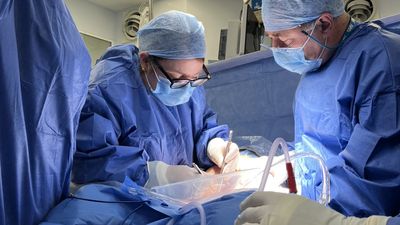
Once the donor womb had been prepared, the implantation surgery took just under seven hours. Bell then underwent IVF and embryo transfer, and her pregnancy was closely monitored.

“There are no words to say thank you enough to my donor and her family. Their kindness and selflessness to a complete stranger is the reason I have been able to fulfil my lifelong dream of being a mum,” Bell said in a statement.
“My hope is that one day this option to motherhood will become much more accessible, so others may have the same chance I have been given.”
Bell is the first person to give birth from a donor womb as part of a transplant research program funded by the charity Womb Transplant UK, which will see a total of 10 transplants from deceased donors. The procedure is still experimental and isn't included in usual organ donation processes, so special permission is required from donors’ families.
The parents of the donor in this case spoke about what it means to them: “As her parents, we feel tremendous pride at the legacy she leaves behind – a legacy of compassion, courage, and love that continues to touch lives even after her passing. We urge others to consider donation, so that more people in desperate need may be given the chance to live, just as our daughter so selflessly wished.”
The founder of Womb Transplant UK and co-lead of this project is Professor Richard Smith, who said, “I’m so happy for Grace, Steve [Powell, her partner] and their family. It was just wonderful to be there at the birth and to see baby Hugo coming into the world, after our journey with this family and the many years of research that led us to this moment.” Little Hugo was given the middle name Richard in his honor.
“Many congratulations to everyone involved, especially Professor Richard Smith, Miss Bryony Jones and the maternity team at Queen Charlotte's and Chelsea Hospital. I'm delighted we were able to welcome baby Hugo into the world at our hospital,” said Professor Tim Orchard, chief executive of Imperial College Healthcare NHS Trust.