Space and Physics
 PUBLISHED





The relationship between friction and load, quantified three centuries ago, has an exception when the interaction causes magnetic realignment. The discovery won’t let you off the hook when dragging furniture around, but it could be useful in the design of advanced materials.
The rest of this article is behind a paywall. Please sign in or subscribe to access the full content.In 1699, French physicist Guillaume Amontons mathematically expressed something that people had previously only understood through intuition – the heavier something is, the more frictional force must be overcome to move it, provided the surfaces are the same.
This idea, that the force of friction is proportional to the load, had been noted centuries before by Leonardo da Vinci, but it had gone unnoticed in the volume of his genius. Amonton’s second law of friction is the much less intuitive observation that the frictional force isn't affected by the area of contact between an object and the surface it moves over.
Almost a century later, Charles-Augustin de Coulomb found some exceptions to these laws, but nevertheless proved them and added a third, ensuring their collective entry into scientific canon. Now, however, a new exception has been found when two magnetic layers interact, which induces a frictional force between them.
The conventional friction Amonton was referring to is understood as being a product of solid objects not being perfectly smooth. When an object moves over a surface, the roughness of one bumps into the other, restricting their relative movement. The heavier the object is, the more the projections in its surface are brought into contact with the surface below, increasing the force required to move it.
This, however, all takes place where the two objects make physical contact, but Dr Hongri Gu at the University of Konstanz in Germany and his colleagues decided to see how well the first law holds up when friction is magnetically generated.
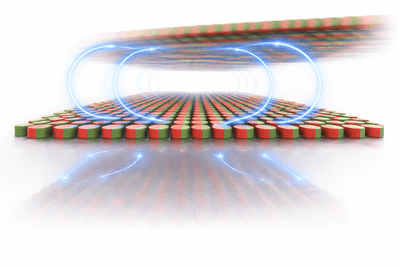
In their experiment, the team created two magnetic layers, with the upper one composed of cylindrical magnets with their axes parallel to the plane of the lower layer. You can imagine them as a set of oil barrels on horizontal spits. The magnets of the upper layer could rotate, whereas similar magnets on the lower layer were fixed so they couldn't rotate.
The two layers never came into contact, held apart by their magnetic repulsion, but friction was created by their interacting fields as one was pushed to slide across the other. The smaller the separation between the two magnets, the stronger the force between them, and therefore the greater the load, equivalent to adding more weight to an object dragged across a rough floor.
“By changing the distance between the magnetic layers, we could drive the system into a regime of competing interactions where the rotors constantly reorganize as they slide,” Gu said in a statement.
When the two elements were far apart, bringing them closer increased the friction, in line with Amonton’s law. However, this eventually reversed, and after a point bringing them closer together actually led to a weaker frictional force.
The authors conclude that this is because the interactions between the two magnets changed the orientation of the magnets in the upper layer. The magnets in the upper layer were subjected to a mix of forces, some pushing them into an alternate direction, others forcing them to align. Near a critical distance, the magnets switched back and forwards as they moved. Their direction depending not only on the forces around them, but their previous alignments.
When the magnets in this system reorient, they dissipate energy. This caused friction to reach a maximum at an intermediate distance, which for this particular design was 8.5 millimeters (0.34 inches). When the two magnets were 6.5 mm (0.26 inches) apart, the magnets aligned, causing lower friction despite a greater load.
“From a theoretical perspective, this system is remarkable because friction does not originate from a physical surface contact, but from the collective dynamics of magnetic moments,” said postgraduate student Anton Lüders, who provided the theoretical description of what was happening.
“What is remarkable is that friction here arises entirely from internal reorganization,” said Professor Clemens Bechinger, who supervised the project. “There is no wear, no surface roughness and no direct contact. Dissipation is generated solely by collective magnetic rearrangements.”
The example might seem rather specific, and some might question if the force observed should be called friction when the two items don’t touch. However, the authors note that similar outcomes are expected with magnetic materials that are only an atom or so thin, and these may prove useful for controlling magnetism.
Ultimately, the researchers hope to be able to adjust friction between surfaces without wearing them out. The authors see value in creating “friction metamaterials”, which they define as “Engineered surfaces that dissipate energy in a programmable manner”.
The study is published in Nature Materials.


 1
1