Nature
 PUBLISHED


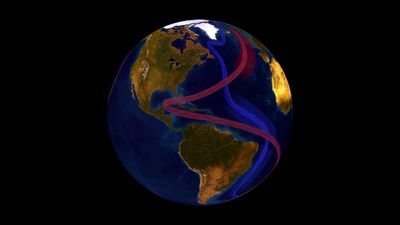


The Atlantic Ocean has a complex system of currents and eddies known as the Atlantic Meridional Overturning Circulation (AMOC), and includes the famous Gulf Stream, which helps with milder temperatures in Northern Europe. Over the last century, however, the AMOC has been slowing down, and new research highlights just how bad things might get for the planet’s climate if it collapses completely.
The rest of this article is behind a paywall. Please sign in or subscribe to access the full content.AMOC is among the deep ocean currents that are driven by the saltiness and temperature of the sea. The unfolding climate crisis has led to the melting of glaciers around the world, reductions of polar ice, and an increase in ocean temperatures. This is affecting the AMOC, which has weakened over the past century.
It is possible that the AMOC will continue to weaken and even collapse. The new study simulated what would happen in that scenario under stable climate conditions, and found something concerning. The collapse would, by itself, push the Atlantic to release carbon dioxide (CO₂) as well as add 0.2 °C (0.36 °F) of extra global warming.
In the simulation, the team analyzed different levels of global atmospheric CO₂ concentration. The shutdown was forced by simply adding freshwater to the ocean, altering its salinity. At the pre-industrial level of CO₂ which is 280 parts per million (ppm) of CO₂, the AMOC recovered once the freshwater forcing stopped. At CO₂ levels of 350ppm, once the AMOC collapsed, it stayed switched off. Atmospheric CO₂ concentrations were last at 350 ppm in 1988. Today they are at 430 ppm.
“Higher CO₂ concentrations fundamentally alter the AMOC's stability, pushing the system into a bistable regime where the AMOC could weaken over hundreds of years before shifting to, and remaining in, a collapsed state. Once shutdown, we see it does not recover in the long run,” lead author Da Nian, from the Potsdam Institute for Climate Impact Research (PIK), said in a statement.
The changes to the AMOC would have global effects, as has been reported in the past. This study alone predicted an increase in temperature between 0.17 °C to 0.27 °C (0.31 to 0.49 °F), if the AMOC were to be off, on top of the warming already occurring due to human action.
“This change in temperatures is driven by a large release of carbon from the Southern Ocean, due to enhanced mixing that brings carbon-rich deep waters to the surface,” explained co-author Matteo Willeit of PIK.
Under a scenario with the shutdown at 450 ppm, Antarctica would see temperatures rise by 6 °C (10.8 °F), while the Arctic temperatures drop by 7 °C (12.6 °F) due to AMOC collapse. The Arctic has been getting warmer faster than the rest of the world, but this scenario would not be good news at all.
“The ocean has been our greatest ally, absorbing a quarter of human-made CO₂ emissions. Our study shows how an AMOC collapse could flip the Southern Ocean from a carbon sink into a carbon source, releasing vast amounts of CO₂ and fueling further global warming. The more CO₂ in our atmosphere at the stage of shutdown, the higher the likelihood of additional warming. Put simply, rising emissions today increase the risk of a stronger climate response down the line,” said PIK Director and co-author Johan Rockström.
The study is published in the journal Communications Earth & Environment.