Nature
 PUBLISHED
 1
1





When Justin Schmidt was just seven years old, he had a run in with a bee that would send him down a curious path. The offending insect was a honeybee that – annoyed it had been plucked it from a dandelion – sank its stinger into the first thing it could. It just so happened that wasn’t Schmidt, but his teacher.
The rest of this article is behind a paywall. Please sign in or subscribe to access the full content.That’s not to say Schmidt hasn't been on the receiving end of his fair share of bites and stings. Writing for The Guardian in 2018, he said he had been stung by just about every stinging insect Appalachia had to offer while growing up.
Those exposures taught him something: every insect sting causes pain, but that pain varies in its intensity and quality. Keen to find out why, he became an entomologist, embarking on a vibrant and eccentric career that ended when he passed away aged 75 in 2023. He leaves behind one hell of a legacy.
You see, Schmidt’s career stands out principally because he established something known as the Schmidt Pain Index. It’s an atlas of all the nasty, burning, hair-pulling stings you can receive from Hymenoptera, the large order of insects that includes ants, bees, and wasps. It ranks each sting on a scale of 1 to 4, and most remarkable of all, Schmidt constructed it based on firsthand experience.
“Whenever I was stung, I would rate the pain, then write a description,” said Schmidt. “At the lower end of the scale, a one, I put the sweat bee, which I describe as: ‘Light, ephemeral, almost fruity. A tiny spark has singed a single hair on your arm.’”
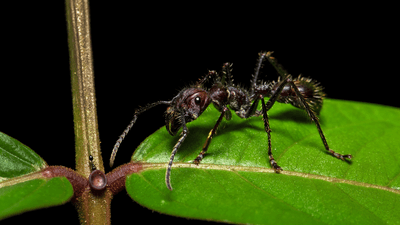
“The twos include the yellowjacket wasp. “Hot and smoky, almost irreverent,” I wrote. The red harvester ant (“Bold and unrelenting. Somebody is using a drill to excavate your ingrown toenail,”) scores a three. But nothing comes close to the bullet ant.”
Schmidt was working in Brazil when a bullet ant, Paraponera clavata, climbed onto his finger and delivered its sting. In its entry in the pain index, he describes it most lyrically as, “Pure, intense, brilliant… Like fire-walking over flaming charcoal with a three-inch rusty nail grinding into your heel.”
You might question his methods, but you have to admit he had style.
According to Schmidt, the closest to the bullet ant are the tarantula hawk wasp and warrior wasp, which also call Central and South America home. The pain they induce lasts for just two minutes and an hour respectively, however, whereas the bullet ant keeps on burning for a gruelling 24-hour period.
A remarkable career for evidently a very tough man, but Schmidt isn’t alone in offering up his own body for scientific research. Just ask the zoologist who volunteered to be parasitized by 50 hookworms in the name of science – something that’s been trialled as a potential treatment for ulcerative colitis.