Humans
 PUBLISHED





Ask historians of math when probability was invented, and you’ll likely get a surprisingly specific answer: 1654. That was the year Pierre de Fermat and Blaise Pascal started writing to each other about an unfinished dice game – some legends say it was their own; others that it was a gambler friend of Pascal’s – trying to work out how best to divide the pot.
The rest of this article is behind a paywall. Please sign in or subscribe to access the full content.But a new study suggests these two mathematical heavyweights were beaten to the punch – and it wasn’t even close. “It looks like that leap happened, possibly for the first time in human history, 12,000 years ago,” says Robert Madden, a PhD student in the Anthropology and Geography department of Colorado State University.
“[It happened] in the New World, amongst supposedly ‘simple’ hunter-gatherers,” Madden tells IFLScience. “And that leap has ended up changing our modern society.”
A game of chance
To come up with the concepts of chance and probability, it’s helpful – perhaps even necessary – to have a demonstration of it. That’s why Pascal and Fermat based their own musings on a game of dice; heck, it’s why even today, we tend to get eased into the topic via coin flips and dice rolls.
And, according to Madden, that’s exactly how the ancient Native Americans came to the idea as well. “Native people had their own indigenous dice and their own dice games,” he explains. “They were used in games of chance, and they were used in gambling.”
It’s hard to overstate just how popular and widespread these dice were – at least in the area around the Rocky Mountains, where the 650-plus dice discovered by Madden originated. “I don't think I've ever seen a record that's this rich,” he says, “where we've got this many examples of stories, this many examples of the pieces and what they're using them for.”
It’s a little surprising that such a hoard went unnoticed until this investigation. After all, the evidence was right there: Madden’s work involved no digging of archaeological sites or painstaking reconstructions of recovered relics – he simply took a more informed look at what was already there.
Over the years, he explains, plenty of archaeological digs had turned up game pieces – but exactly what function they served was “an archaeological Rorschach test”, says Madden. Maybe they were dice; maybe counters; maybe little point markers – nobody really knew for sure. “That uncertainty really prevented anybody from kind of going back and trying to track it.”
So, taking the examples and descriptions of Native American dice already known, he constructed a basic rubric for finding more: “we distill[ed] out a morphological test,” explains Madden. “I used [a] huge database that had been put together in 1907 and distilled out this four-part test for testing the archaeological record.”
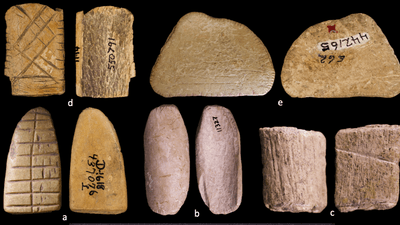
Now, these weren’t the slam-dunk dice we find in Roman sites, for example – six-sided and pipped in a way we still recognize today. In fact, “they were two-sided”, says Madden, more akin to a coin-flip, “and if you pick them up and look at them in section, there's […] different shapes.”
“A lot of them are just flat,” he explains. “Sometimes it'll be discs, like a poker chip. Very common form.” Others looked more like popsicle sticks, he says, possibly held in a fist and dropped, rather than thrown. But, as a general rule, dice “are always going to have two sides […] They're always going to have those two sides differentiated in some way that's clearly discernible. And they have to be small enough [to use]. So that’s the test.”
It might not catch every example of a die that has been found since 1907 – but it should catch some, and it was tight enough to ensure no false positives would get through. “I spent the better part of three years just methodically parsing through [artefacts],” Madden recalls. “[I found] hundreds of them.”
A link to the past
The more Madden looked, the more he found, and some of the pieces he discovered were old. Old old: “They go back all the way back into late Pleistocene,” he says. “They’re 12,000 years old – but they are morphologically, physically identical to these ones that were in historic times.”
“But, boy, that's a long period of time to make that jump and say that's what they were,” he adds.
Understandably, then, previous archaeologists had hesitated to link these super-ancient artefacts with their more modern lookalikes. But with each discovery of a new piece in the dice puzzle, a greater picture started to emerge: “what's nice about [this] study is that you don't have to jump 12,000 years,” Madden explains. “You could just step it back all the way back through time, and there's kind of a continuous line that links [them].”
.png "A figure from a researche paper showing more examples of ancient dice, this time with both faces of 18 examples.")
Now, to say that any society, let alone a whole group of them, was comfortable with the ideas of chance and randomness so early – well, it’s a big claim. But it’s one that’s supported not only by the physical evidence, but by the cultures of the people using the dice, Madden explained – because while ancient and medieval Europeans clung to a perfectly ordered, divinely determined universe, Native Americans embraced the chaos.
“If you look at the traditions of native people that still play these games […] what you see is, the way chance is portrayed, it's really almost like a character. It's like a natural force,” Madden points out. “It’s something that even the gods are subject to.”
“There are stories where the gods – they want to do things, but the outcome is going to be determined by a game of chance,” he explains.
Relative chances
It’s odd that so many of these pieces should have been found around the Rockies, while hardly any turned up in the eastern US – a puzzle even Madden struggles to explain: “I really did expect to find them all over North America,” he says, “and it was very surprising [that I didn’t].”
Could it be that eastern groups used more fragile materials, or had harsher soil conditions? Did they only come into those regions after European contact, perhaps? Or maybe Madden just missed them? All are possible – but “I don't think any of those are it,” he says.
Instead, he explained, you have to look at the tribes where dice were found – and what sets them apart from those in the east. Then it’s obvious: “the Indigenous people that are in those areas, they tend to be highly mobile […] The resources are very spread out, particularly on the east side, over in the desert country.”
“So these are people that would need to be able to relate to, and trade with, and have interactions with people that they didn't know very well,” he explains. “That would be important for in terms of getting knowledge, exchanging mates, just, you know, just social interaction.”
Dice games weren’t just a manifestation of mythical lore, therefore – they were a vital social lubricant; a way to break the ice and stay civil with perfect strangers. They could be used as “fair” ways to mete out resources among people with no particular relationship connecting them.
They could also serve as a quick and efficient way to make a trade – quicker and more efficient, at least, than the normal way: “I bring you a gift,” says Madden, “and it creates kind of a diffuse obligation [for you] to maybe sometime in the future give me a gift [that] may not have anything to do with the value of what I gave you.”
It's an interesting social note, sure, but it’s also yet more evidence for an appreciation of the laws of chance and probability among the Native Americans who used them. After all, it’s only with an understanding of expectations that you can intuit something like the law of large numbers – or in less mathematical terms, trust that it’ll all break even eventually.
Hiding in plain sight
To expand the historical record by a factor of four is no mean feat on its own – but if these countless ancient dice discoveries really do signal that Pleistocene people had an understanding of probability, it could mark a paradigm shift in how we view both topics.
“Worldwide […] it's pretty rare for, let's call them ‘traditional’ societies, ‘non-modern’ societies, to have a conception of chance at all,” Madden tells IFLScience. “I mean, it's pretty late in European society […] and they were looking at dice [too].”
“But one of the things that archaeology teaches us is that there's always something like that out there,” he says. “We always underestimate what people are capable of – and we're always surprised.”
The paper is published in the journal American Antiquity.