Nature
 PUBLISHED




“Someone’s having a great day out,” I recently said to my mother upon spotting a bumblebee at the garden center. At first I saw a charming fuzz-ball, zooming around to get its fill of what – to a bee – must seem like an all-you-can-eat buffet. Then I watched its six legs manipulating the petals of a flower, prizing it open to get what it wanted, and I remembered – bees can be absolutely savage.
The rest of this article is behind a paywall. Please sign in or subscribe to access the full content.I say that as a marker of respect, not judgment, through the new lens with which I observe bee life having watched National Geographic’s Secrets Of The Bees, presented by cinematographer and NatGeo explorer Bertie Gregory.
They have just as much charisma and character as any of those animals. You just have to get down on their level and see the world through their eyes.
Bertie Gregory
The title might prompt some to question: What secrets? After all, do we really have much left to learn from these small insects we’re all already so familiar with? Dear reader, don’t be so foolish. You see, bees have just as much going on as any macro predator.
“This was a misconception that I had going into the project,” said Gregory to IFLScience. “I thought, ‘How on Earth are bees going to have the same charisma that the previous Secrets Of series have had?’ – the penguins and whales and elephants. It turns out they have just as much charisma and character as any of those animals. You just have to get down on their level and see the world through their eyes.”
Seeing the world through their eyes was a task Director of Photography John Brown rose to in capturing Gregory's favourite scene in the whole film. “It reminds me of the battle for Helm's Deep in The Lord of the Rings,” he said, and I’m inclined to agree.
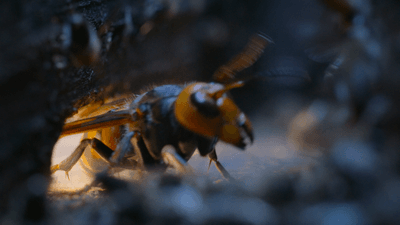
As one of the top macro cinematographers in the world, Brown found an innovative way to capture the drama from inside an Asian honeybee hive that came under attack from murder hornets. The fray begins with a murder hornet scouting out the hive, triggering the bees to gather and shimmer their bodies as an intimidation tactic.
When they've been scent marked, they go out and collect a very particular type of a plant that they break up and rub to try and mask the scent. That's tool use.
Bertie Gregory
It proves unsuccessful as the scout hornet scent marks the hive. A signal to its sisters that they’ll be returning to launch a full-scale attack, but it doesn’t go unnoticed.
“I think the most amazing part of that scene, behaviorally, is not the cooking bit [we’ll get to this shortly],” said Gregory. “It's the bit where they try to foil the hornet’s scent marker.”
“When a hornet finds a hive, they plant a pheromone like a like a marker so that they can go get all their sisters and then come back with a full the full army. The honeybees know this. So, when they've been scent marked, they go out and collect a very particular type of a plant that they break up and rub to try and mask the scent. That's tool use.”
Their efforts aren’t enough to prevent the murder hornets from returning on this occasion, however, to the detriment of both the bees and the hornets.
The bees retreat into their hive through an entrance that’s too narrow for a hornet. No problem, says the murder hornet that proceeds to chew through the wood as the bees look on. That is, until the hornet steps inside.
The bees then swarm the hornet forming a vibrating mass that generates temperatures of around 46°C (115°F) – hot enough to cook it to death. Something they can do again and again as more murder hornets arrive.
If you’re not surprised to learn that bees can fight back, then perhaps you’ll be more impressed by the fact that some of them have adapted to make honey from rotting meat.
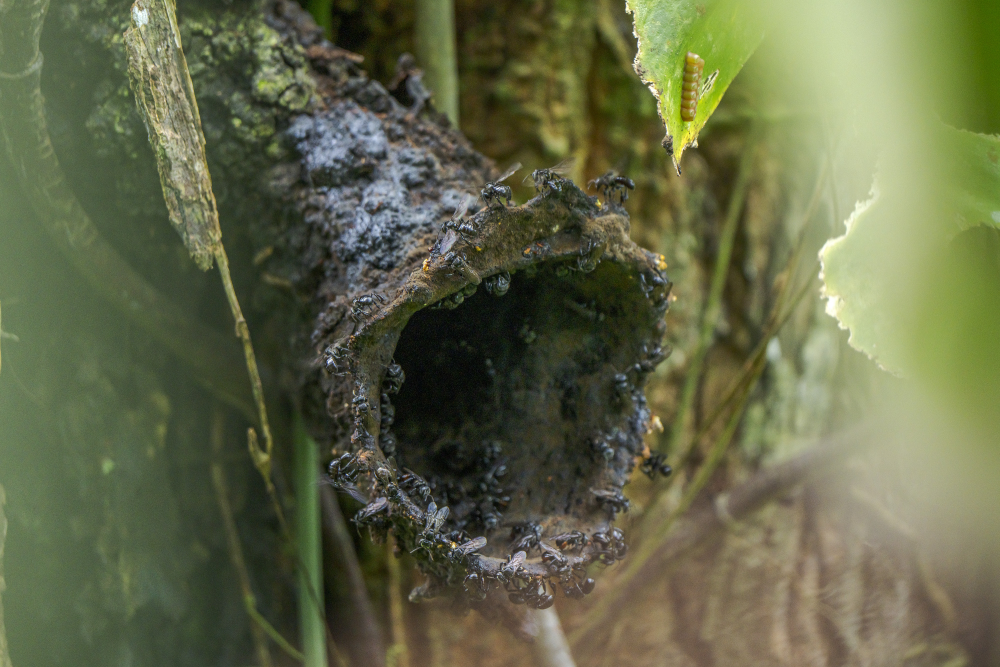
“The bees in the Amazon have a very interesting challenge because you kind of assume that the Amazon rainforest is full of flowers, but relatively speaking, it's not,” said Gregory. “So, they need to come up with other ways to create honey. Vulture bees are able to break down rotting flesh and turn that into honey.”
In the film, the rotting flesh is that of a dead fish, which got me wondering…
“Does it taste fishy? That's a great question,” said Gregory. “I don't know the answer to that, but I'm not sure I want to try it, thanks.”
Without them, we would have very difficult, if not impossible, lives.
Bertie Gregory
See – I told you. The bees still have some secrets, but what we’ve learned of them so far paints a picture of an immensely complex, intelligent, social, and – yes, sometimes – fierce group of animals represented by over 20,000 species that are responsible for pollinating a third of the world’s food.
“They play this incredibly important role in pollination and helping plants reproduce,” said Gregory. “Without them, we would have very difficult, if not impossible, lives. So, regardless of whether or not you love bees, you should really value them.”
Secrets Of The Bees, executive produced by James Cameron, premieres on National Geographic WILD at 7pm (Central time) on April 1 and streams on Disney+ the same day.